Dear Joshua, I am not sure why you need to separate both components? What’s wrong with simply running EasyReg iteratively? It won’t be any slower, since the affine transform is computed almost instantaneously from the segmentations? Cheers, /E
-- Juan Eugenio Iglesias http://www.jeiglesias.com
From: freesurfer-bounces@nmr.mgh.harvard.edu freesurfer-bounces@nmr.mgh.harvard.edu on behalf of Joshua K Lee jkilee@ucdavis.edu Date: Saturday, September 7, 2024 at 12:59 PM To: Freesurfer support list freesurfer@nmr.mgh.harvard.edu Subject: [Freesurfer] using easy_reg to build unbiased template: separating linear and non linear components
External Email - Use Caution apologies if this is a duplicate, I seem to be having some trouble with the listserv.
[cid:5208cb3b-161c-4601-9f9c-1dd8840a03da] I've really impressed with mri_easy_reg and I was hoping to use it in a similar way as ANTs built_template scripts, which requires separation of affine from nonlinear transforms for their unbiased template updating algorithm. However, mri_easy_reg only returns a single transform object, combining affine and nonlinear components.
I added an argument as an option for producing separate transforms
``` def main(): parser.add_argument("--separate_transforms", default=None, help="(optional) Produce Affine and NonLinear Fields Separately, if 'a' produce combined transform too. If 'b', do not produce combined transform") ```
then include ``` if args.separate_transforms is not None: sepAII3 = II2 sepAJJ3 = JJ2 sepAKK3 = KK2 sepAaffine = torch.tensor(np.matmul(Mflo, atlas_aff), device='cpu') sepARAS_X = affine[0, 0] * sepAII3 + affine[0, 1] * sepAJJ3 + affine[0, 2] * sepAKK3 + affine[0, 3] sepARAS_Y = affine[1, 0] * sepAII3 + affine[1, 1] * sepAJJ3 + affine[1, 2] * sepAKK3 + affine[1, 3] sepARAS_Z = affine[2, 0] * sepAII3 + affine[2, 1] * sepAJJ3 + affine[2, 2] * sepAKK3 + affine[2, 3] ``` and ``` if args.separate_transforms is not None: #create separate nonlinear naked field ndepth, nheight, nwidth, _ = f2r_field.shape # Create meshgrid indices for each dimension nII, nJJ, nKK = np.meshgrid(np.arange(ndepth), np.arange(nheight), np.arange(nwidth), indexing='ij') # Convert numpy arrays to PyTorch tensors nII2 = torch.tensor(nII, dtype=torch.float32, device='cpu') # or device='cuda' if using GPU nJJ2 = torch.tensor(nJJ, dtype=torch.float32, device='cpu') nKK2 = torch.tensor(nKK, dtype=torch.float32, device='cpu') # Now use these tensors as inputs to your interpolation function nFIELD = fast_3D_interp_field_torch(f2r_field, nII2, nJJ2, nKK2) nII3 = nII2 + nFIELD[:, :, :, 0] nJJ3 = nJJ2 + nFIELD[:, :, :, 1] nKK3 = nKK2 + nFIELD[:, :, :, 2] ``` ``` and saves them if args.separate_transforms is not None: print("args.separate_transforms is not None") # Correctly combine the prefix with the filename fwd_field_dir = os.path.dirname(args.fwd_field) fwd_field_basename = os.path.basename(args.fwd_field) nonlinear_fwd_field = os.path.join(fwd_field_dir, nonlinear_prefix + fwd_field_basename) print(f" Saving nonlinear field to: {nonlinear_fwd_field}") try: nonlinear_field = torch.stack([nII3, nJJ3, nKK3], axis=-1) print(f" Nonlinear field shape: {nonlinear_field.shape}") save_volume(nonlinear_field, Raff, Rh, nonlinear_fwd_field, n_dims=3) print(" Nonlinear field saved successfully") except Exception as e: print(f" Error saving nonlinear field: {str(e)}")
# Do the same for the affine field affine_fwd_field = os.path.join(fwd_field_dir, affine_prefix + fwd_field_basename) print(f" Saving affine field to: {affine_fwd_field}") try: save_volume(torch.stack([sepARAS_X, sepARAS_Y, sepARAS_Z], axis=-1), Raff, Rh, affine_fwd_field, n_dims=3) print(" Affine field saved successfully") except Exception as e: print(f" Error saving affine field: {str(e)}") ``` full python file attached.
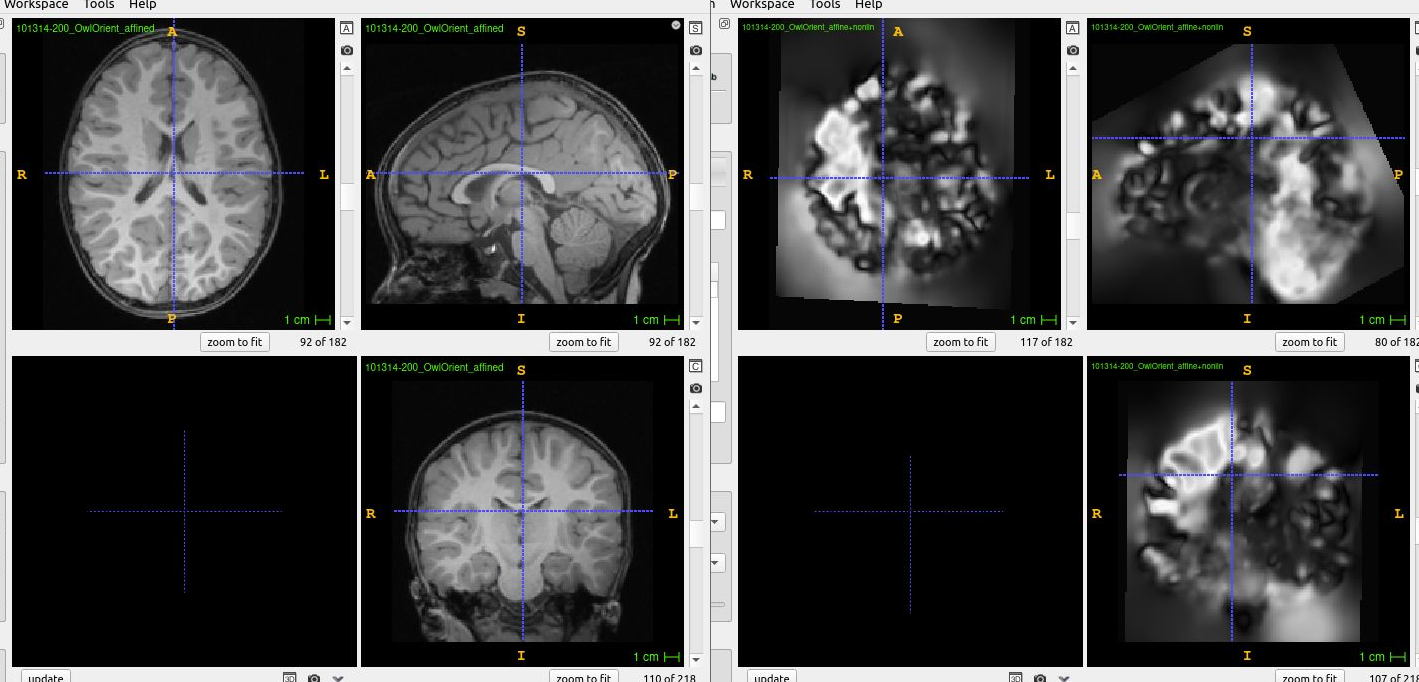
but it doesn't work. When I try applying them to floating image one at a time, the images go haywire. On the left is after applying the affine transform my code generated, on the right is applying the nonlinear transform onto the image on the left.
Josh Lee
Assistant Professional Researcher
Department of Psychiatry and Behavioral Sciences
University of California, MIND Institute
jkilee@ucdavis.edu