
Hey, Is there a way to add structures/labels to a pre-existing annotation file? I sampled an annotated atlas onto a subjects surface. But when I load the annotation and try to create a new label, I can't export the edited annotation without eliminating the new label. I tried to create a new color lookup table with the new structure included, and I can load the table in tksurfer just fine. However, when I also try to import the pre-existing annotation(in order to edit it), the color table existing in the annotation overrides the color lookup table I load. If it try to load the table after importing the annotation, the new structure/label does not show up in the label window. If anyone can help me with this issue, that would be great, thanks! -Eric

Hi,
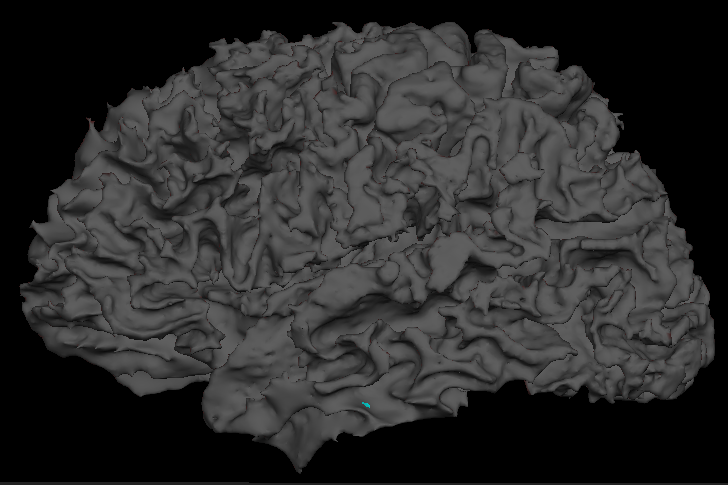
We are starting to use freesurfer to analyse some 400 brains. Many of the white matter surface reconstructions we are obtaining look quite noisy, with 'spikes' or 'protrusions' (I attach an image) and I wonder if these are normal results.... I would have thought that the white matter surface was smoother... does this surface look like what other people in the list are obtaining?
Second thing, concerning the folding index measures (Van Essen's folding index, FI):
FI = integral (Kmax * (Kmax-Kmin))
If the protrusions are artifacts, and as they are so sharp, wouldn't the FI be dominated by the high curvature of the protrusions? I thought that smoothing the surface before computing the FI may help take ride of these high frequencies. Is it possible to do this?
Finally, does someone in the list know of a paper(s) correlating the folding index to something else? (I asked this already some months ago)
Thanks in advance for your help!
best regards, roberto
This message has been checked for viruses but the contents of an attachment may still contain software viruses, which could damage your computer system: you are advised to perform your own checks. Email communications with the University of Nottingham may be monitored as permitted by UK legislation.

Hi Roberto,
it's impossible to assess the accuracy of a surface from just the surface rendering. Does the position of the ?h.white surface look accurate when overlaid on the volume in tkmedit? That should be your gold standard.
We have a couple of studies in progress looking at the relationship of the folds to various disorders. There have been a few recent papers doing something similar, but I don't have the refs handy.
cheers, Bruce
On Thu, 9 Nov 2006, Roberto Toro wrote:
Hi,
We are starting to use freesurfer to analyse some 400 brains. Many of the white matter surface reconstructions we are obtaining look quite noisy, with 'spikes' or 'protrusions' (I attach an image) and I wonder if these are normal results.... I would have thought that the white matter surface was smoother... does this surface look like what other people in the list are obtaining?
Second thing, concerning the folding index measures (Van Essen's folding index, FI):
FI = integral (Kmax * (Kmax-Kmin))
If the protrusions are artifacts, and as they are so sharp, wouldn't the FI be dominated by the high curvature of the protrusions? I thought that smoothing the surface before computing the FI may help take ride of these high frequencies. Is it possible to do this?
Finally, does someone in the list know of a paper(s) correlating the folding index to something else? (I asked this already some months ago)
Thanks in advance for your help!
best regards, roberto
This message has been checked for viruses but the contents of an attachment may still contain software viruses, which could damage your computer system: you are advised to perform your own checks. Email communications with the University of Nottingham may be monitored as permitted by UK legislation.
freesurfer@nmr.mgh.harvard.edu
-
 Bruce Fischl
 -
 Eric Feczko
 -
 Roberto Toro