
So I created a weighted regression analysis to look at the effect of memory load in a particular brain region. Basically, I weighted the paradigms by a behavioral measure that reflected the number of items actually remembered (as set size was increased). As far as Doug told me there are basically 2 ways to weight your paradigm files.
Version 1: Have 2 conditions, baseline (condition 0) and all the set sizes (condition 1). Condition 1 would then be weighted by the behavioral measure.
Version 2: Have 3 conditions, baseline (condition 0), and then I represented each presentation as two different conditions, one with a weight that is always 1 (condition 1), the other weighted according to the behavioral measure (condition 2).
The difference, as far as I understand it, in version 1, it is assumed that the response amplitude is ) when the weight is 0 (ie. that when you are attending to 0 items, brain activity = 0). Whereas, version 2, tests the slope of the HRF amplitude vs weight without the assumption above.
However, I'm a bit confused as to the results I got. When I looked at the data from both versions, version 1 provided a much higher amount of activation and more areas activated than version 2. However, I believe version 2 better fits with the multiple regression analysis that is done in Brain Voyager.
Can anyone give me a better explanation of what the difference between these analysis models is?
Katie

I assume that you are comparing maps of Version1:1v0 and Version2:2v0 ? I could imagine it going either way. If the true slope is 0 but the offset is non-0, then Version1 will give you an artificially high slope (and Verion2 will give you the correct slope at 0, and so no activation). Are you comparing this to a BV analysis?
doug
Katie Bettencourt wrote:
So I created a weighted regression analysis to look at the effect of memory load in a particular brain region. Basically, I weighted the paradigms by a behavioral measure that reflected the number of items actually remembered (as set size was increased). As far as Doug told me there are basically 2 ways to weight your paradigm files.
Version 1: Have 2 conditions, baseline (condition 0) and all the set sizes (condition 1). Condition 1 would then be weighted by the behavioral measure.
Version 2: Have 3 conditions, baseline (condition 0), and then I represented each presentation as two different conditions, one with a weight that is always 1 (condition 1), the other weighted according to the behavioral measure (condition 2).
The difference, as far as I understand it, in version 1, it is assumed that the response amplitude is ) when the weight is 0 (ie. that when you are attending to 0 items, brain activity = 0). Whereas, version 2, tests the slope of the HRF amplitude vs weight without the assumption above.
However, I'm a bit confused as to the results I got. When I looked at the data from both versions, version 1 provided a much higher amount of activation and more areas activated than version 2. However, I believe version 2 better fits with the multiple regression analysis that is done in Brain Voyager.
Can anyone give me a better explanation of what the difference between these analysis models is?
Katie
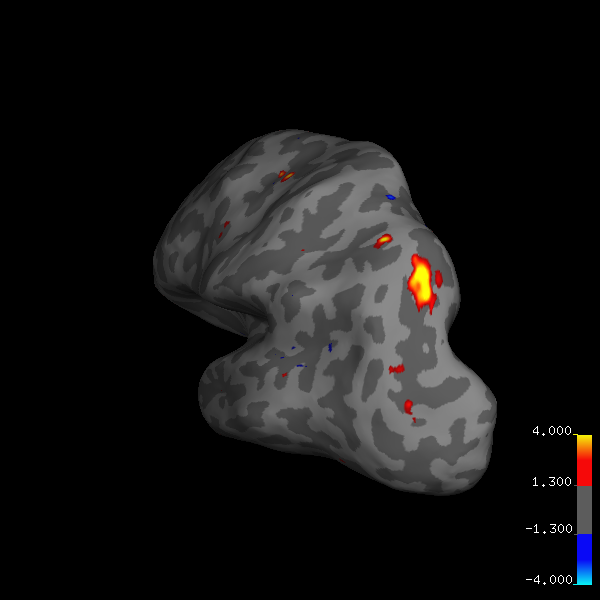
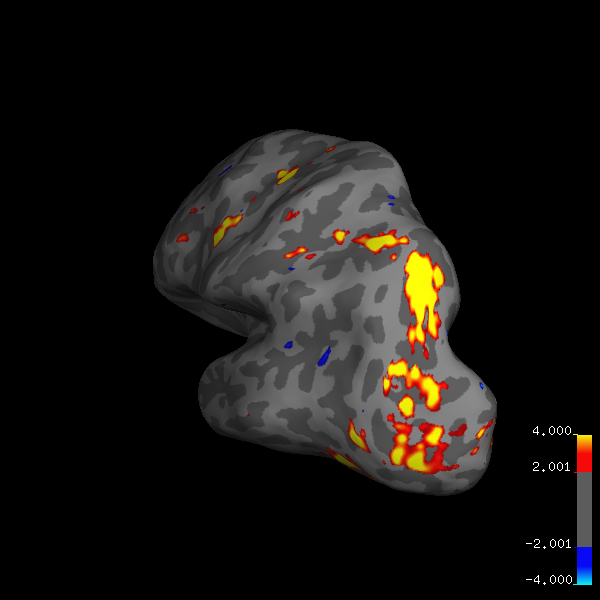
Yes, those are the maps I"ve been comparing. I've been comparing it to BV sort of, but that analysis is not surface based and I"m not used to it, so I can't quite tell which is more accurate, though Version 2 gives a much smaller area of activity, which fits with the description of what I've been given about what to expect in BV. Attached is two pictures of the difference I get for Version 1:1v0 (labeled with "single" in the image name) and Version 2:2v0 (labeled with "double" in the name). As you can see, Version1 activates a much larger area than Version 2.
I guess part of my problem is that I'm having trouble understanding exactly what these two versions are telling me about the data and what the differences is. Can you try to give me a sort of layman's explanation?
Katie
On Tue, Feb 22, 2011 at 11:45 AM, Douglas N Greve <greve@nmr.mgh.harvard.edu
wrote:
I assume that you are comparing maps of Version1:1v0 and Version2:2v0 ? I could imagine it going either way. If the true slope is 0 but the offset is non-0, then Version1 will give you an artificially high slope (and Verion2 will give you the correct slope at 0, and so no activation). Are you comparing this to a BV analysis?
doug
Katie Bettencourt wrote:
So I created a weighted regression analysis to look at the effect of memory load in a particular brain region. Basically, I weighted the paradigms by a behavioral measure that reflected the number of items actually remembered (as set size was increased). As far as Doug told me there are basically 2 ways to weight your paradigm files.
Version 1: Have 2 conditions, baseline (condition 0) and all the set sizes (condition 1). Condition 1 would then be weighted by the behavioral measure.
Version 2: Have 3 conditions, baseline (condition 0), and then I represented each presentation as two different conditions, one with a weight that is always 1 (condition 1), the other weighted according to the behavioral measure (condition 2).
The difference, as far as I understand it, in version 1, it is assumed that the response amplitude is ) when the weight is 0 (ie. that when you are attending to 0 items, brain activity = 0). Whereas, version 2, tests the slope of the HRF amplitude vs weight without the assumption above.
However, I'm a bit confused as to the results I got. When I looked at the data from both versions, version 1 provided a much higher amount of activation and more areas activated than version 2. However, I believe version 2 better fits with the multiple regression analysis that is done in Brain Voyager. Can anyone give me a better explanation of what the difference between these analysis models is?
Katie
-- Douglas N. Greve, Ph.D. MGH-NMR Center greve@nmr.mgh.harvard.edu Phone Number: 617-724-2358 Fax: 617-726-7422
Bugs: surfer.nmr.mgh.harvard.edu/fswiki/BugReporting FileDrop: www.nmr.mgh.harvard.edu/facility/filedrop/index.html
The information in this e-mail is intended only for the person to whom it is addressed. If you believe this e-mail was sent to you in error and the e-mail contains patient information, please contact the Partners Compliance HelpLine at http://www.partners.org/complianceline . If the e-mail was sent to you in error but does not contain patient information, please contact the sender and properly dispose of the e-mail.
You should also look at Version2:1v0. I bet a lot of the areas from Version1:1v0 will also show up. You can also create a Version3 in which you divide your presentations into a low-weight and a high-weight (but set the weight=1). Then create contrasts of low+high and high-low. The low+high should look like Version2:1v0 and the high-low should look like Version2:2v0.
doug
Katie Bettencourt wrote:
Yes, those are the maps I"ve been comparing. I've been comparing it to BV sort of, but that analysis is not surface based and I"m not used to it, so I can't quite tell which is more accurate, though Version 2 gives a much smaller area of activity, which fits with the description of what I've been given about what to expect in BV. Attached is two pictures of the difference I get for Version 1:1v0 (labeled with "single" in the image name) and Version 2:2v0 (labeled with "double" in the name). As you can see, Version1 activates a much larger area than Version 2.
I guess part of my problem is that I'm having trouble understanding exactly what these two versions are telling me about the data and what the differences is. Can you try to give me a sort of layman's explanation?
Katie
On Tue, Feb 22, 2011 at 11:45 AM, Douglas N Greve <greve@nmr.mgh.harvard.edu mailto:greve@nmr.mgh.harvard.edu> wrote:
I assume that you are comparing maps of Version1:1v0 and
Version2:2v0 ? I could imagine it going either way. If the true
slope is 0 but the offset is non-0, then Version1 will give you an
artificially high slope (and Verion2 will give you the correct
slope at 0, and so no activation). Are you comparing this to a BV
analysis?

doug


Katie Bettencourt wrote:

    So I created a weighted regression analysis to look at the
    effect of memory load in a particular brain region. Basically,
    I weighted the paradigms by a behavioral measure that
    reflected the number of items actually remembered (as set size
    was increased).  As far as Doug told me there are basically 2
    ways to weight your paradigm files.

    Version 1:
    Have 2 conditions, baseline (condition 0) and all the set
    sizes (condition 1).  Condition 1 would then be weighted by
    the behavioral measure.

    Version 2:
    Have 3 conditions, baseline (condition 0), and then I
    represented each presentation as two different conditions, one
    with a weight that is always 1 (condition 1), the other
    weighted according to the behavioral measure (condition 2).


    The difference, as far as I understand it, in version 1, it is
    assumed that the response amplitude is ) when the weight is 0
    (ie. that when you are attending to 0 items, brain activity =
    0).  Whereas, version 2, tests the slope of the HRF amplitude
    vs weight without the assumption above.

    However, I'm a bit confused as to the results I got.  When I
    looked at the data from both versions, version 1 provided a
    much higher amount of activation and more areas activated than
    version 2.  However, I believe version 2 better fits with the
    multiple regression analysis that is done in Brain Voyager.
    Can anyone give me a better explanation of what the difference
    between these analysis models is?

    Katie


--
Douglas N. Greve, Ph.D.
MGH-NMR Center
greve@nmr.mgh.harvard.edu <mailto:greve@nmr.mgh.harvard.edu>
Phone Number: 617-724-2358 Fax: 617-726-7422

Bugs: surfer.nmr.mgh.harvard.edu/fswiki/BugReporting
<http://surfer.nmr.mgh.harvard.edu/fswiki/BugReporting>
FileDrop: www.nmr.mgh.harvard.edu/facility/filedrop/index.html
<http://www.nmr.mgh.harvard.edu/facility/filedrop/index.html>


The information in this e-mail is intended only for the person to
whom it is
addressed. If you believe this e-mail was sent to you in error and
the e-mail
contains patient information, please contact the Partners
Compliance HelpLine at
http://www.partners.org/complianceline . If the e-mail was sent to
you in error
but does not contain patient information, please contact the
sender and properly
dispose of the e-mail.
freesurfer@nmr.mgh.harvard.edu
-
 Douglas N Greve
 -
 Katie Bettencourt