
External Email - Use Caution
Good afternoon
Is there is way to automatically extract the anatomical locations corresponding to a set of RAS coordinates using Freesurfer's atlas? I have a set of 200 points and I am trying to get their anatomical labels automatically.
Thank you Sparsh

First, you'll have to find the closest vertex for each point in fsavarage. You can do this with by creating a label file then using mri_label2label with the --paint option.
To find the label associated with each vertex, it is probably easiest to use matlab using read_surf.m and read_annotation.m
On 2/5/19 11:17 AM, Sparsh Jain wrote:
External Email - Use Caution
Good afternoon
Is there is way to automatically extract the anatomical locations corresponding to a set of RAS coordinates using Freesurfer's atlas? I have a set of 200 points and I am trying to get their anatomical labels automatically.
Thank you Sparsh
Freesurfer mailing list Freesurfer@nmr.mgh.harvard.edu https://mail.nmr.mgh.harvard.edu/mailman/listinfo/freesurfer
External Email - Use Caution
Hi Doug,
I tried what you suggested, but it did not work (see below for details of what we tried). We have TkReg RAS coordinates (or vertex points) for our electrode contacts; most contacts are *deep within the brain* (e.g., hippocampus and amygdala). We want to get a variable in Matlab that will give us the anatomical labels as a function of the TkReg RAS coordinates (or vertex points). How can we do this?
Thanks!
Sparsh
*What I tried:* I read the 'rh.aparc.2009a.annot' file in matlab using read_annotation.m. That gave me 76 labels for right hemisphere, which I believe correspond to the surface parcellations only. In freeview I loaded the orig.mgz, aparc.a2009s+aseg.mgz, rh.pial and rh.inflated. I then clicked on a cortical surface point to see if I can get the corresponding vertex number or structure ID. On doing so, I found a value in the Vertex row under rh.pial of freeview but this number wasn't found in the matlab output (in the colortable.label or colortable.table). I think I am looking in the wrong place to find the vertex # on freeview.
Also, I did not find a readable file for the segmentation data. I tried to read the aparc.a2009s+aseg.mgz on Matlab but that didn't work. Show quoted text
On Thu, 7 Feb 2019, 16:10 Greve, Douglas N.,Ph.D. <DGREVE@mgh.harvard.edu wrote:
First, you'll have to find the closest vertex for each point in fsavarage. You can do this with by creating a label file then using mri_label2label with the --paint option.
To find the label associated with each vertex, it is probably easiest to use matlab using read_surf.m and read_annotation.m
On 2/5/19 11:17 AM, Sparsh Jain wrote:
External Email - Use CautionGood afternoon
Is there is way to automatically extract the anatomical locations corresponding to a set of RAS coordinates using Freesurfer's atlas? I have a set of 200 points and I am trying to get their anatomical labels automatically.
Thank you Sparsh
Freesurfer mailing list Freesurfer@nmr.mgh.harvard.edu https://mail.nmr.mgh.harvard.edu/mailman/listinfo/freesurfer
Freesurfer mailing list Freesurfer@nmr.mgh.harvard.edu https://mail.nmr.mgh.harvard.edu/mailman/listinfo/freesurfer
For a volume, I would do it differently. In matlab
[segcodes segnames ] = read_fscolorlut(); % read in the seg lookup table
aparcaseg = MRIread('aparc+aseg.mgz'); % Load in the volume crs = round(inv(aparcaseg.tkrvox2ras)*[tkr tka tks 1]')+1; % convert your tkreg coords to col, row, and slice c = crs(1); r = crs(2); s = crs(3); segno = aparcaseg.vol(r,c,s); % extract the segmentation number ind = find(segno == segcodes); % convert to the ne name of the segmentation segname = segnames(ind,:)
On 2/20/19 9:58 AM, Sparsh Jain wrote:
External Email - Use Caution
Hi Doug,
I tried what you suggested, but it did not work (see below for details of what we tried). We have TkReg RAS coordinates (or vertex points) for our electrode contacts; most contacts are _deep within the brain_ (e.g., hippocampus and amygdala). We want to get a variable in Matlab that will give us the anatomical labels as a function of the TkReg RAS coordinates (or vertex points). How can we do this?
Thanks!
Sparsh
_What I tried:_ I read the 'rh.aparc.2009a.annot' file in matlab using read_annotation.m. That gave me 76 labels for right hemisphere, which I believe correspond to the surface parcellations only. In freeview I loaded the orig.mgz, aparc.a2009s+aseg.mgz, rh.pial and rh.inflated. I then clicked on a cortical surface point to see if I can get the corresponding vertex number or structure ID. On doing so, I found a value in the Vertex row under rh.pial of freeview but this number wasn't found in the matlab output (in the colortable.label or colortable.table). I think I am looking in the wrong place to find the vertex # on freeview.
Also, I did not find a readable file for the segmentation data. I tried to read the aparc.a2009s+aseg.mgz on Matlab but that didn't work. Show quoted text
On Thu, 7 Feb 2019, 16:10 Greve, Douglas N.,Ph.D. <DGREVE@mgh.harvard.edu mailto:DGREVE@mgh.harvard.edu wrote:
First, you'll have to find the closest vertex for each point in
fsavarage. You can do this with by creating a label file then using
mri_label2label with the --paint option.

To find the label associated with each vertex, it is  probably
easiest
to use matlab using read_surf.m and read_annotation.m

On 2/5/19 11:17 AM, Sparsh Jain wrote:
>
>         External Email - Use Caution
>
> Good afternoon
>
> Is there is way to automatically extract the anatomical locations
> corresponding to a set of RAS coordinates using Freesurfer's
atlas? I
> have a set of 200 points and I am trying to get their anatomical
> labels automatically.
>
> Thank you
> Sparsh
>
> _______________________________________________
> Freesurfer mailing list
> Freesurfer@nmr.mgh.harvard.edu
<mailto:Freesurfer@nmr.mgh.harvard.edu>
> https://mail.nmr.mgh.harvard.edu/mailman/listinfo/freesurfer


_______________________________________________
Freesurfer mailing list
Freesurfer@nmr.mgh.harvard.edu <mailto:Freesurfer@nmr.mgh.harvard.edu>
https://mail.nmr.mgh.harvard.edu/mailman/listinfo/freesurfer
Freesurfer mailing list Freesurfer@nmr.mgh.harvard.edu https://mail.nmr.mgh.harvard.edu/mailman/listinfo/freesurfer
External Email - Use Caution
Thank you so much for the help! I got it to work.
While most of the labels were correct, the matlab script returned the wrong location for one point . The script returned the label 'right cerebral white matter' for a point that seems to lie in the middle of the right amygdala. I have attached the screenshots. I do not think that there is a white matter area close enough to confuse the script. Could you tell me why this may have occurred? When I write the line "crs = round(inv(aparcaseg.tkrvox2ras)*[tkr tka tks 1]')+1" , is there an error due to rounding in the conversion?
I was planning to inflate a sphere around each electrode point and get the neighboring anatomical regions as well.
Sparsh
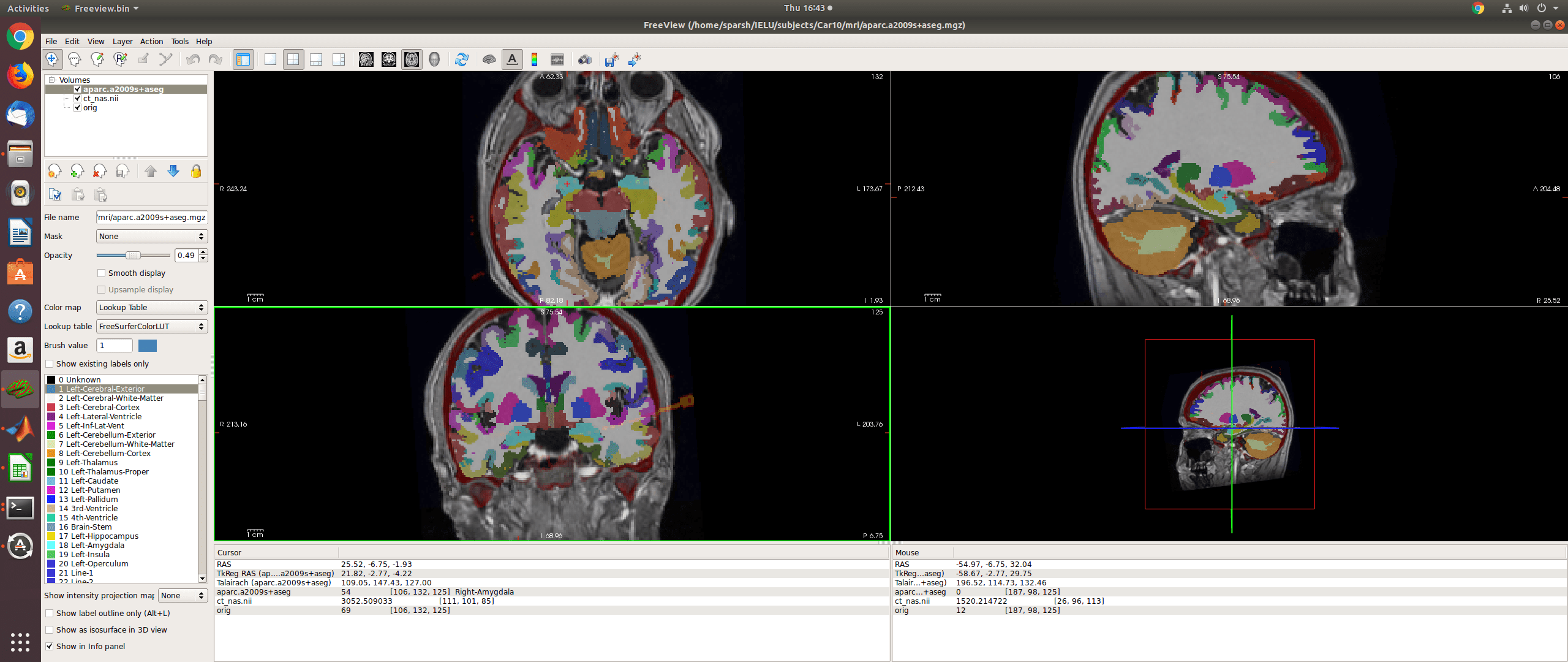
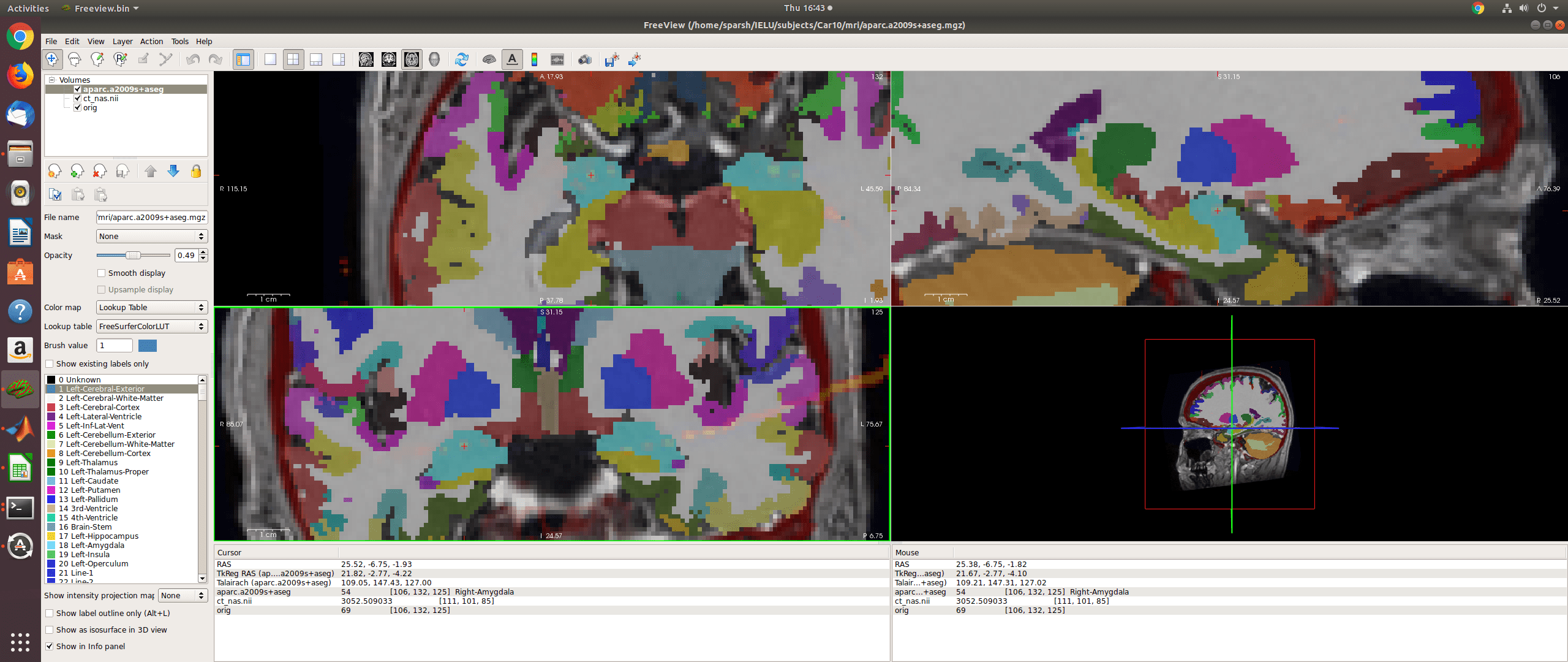
External Email - Use Caution
Thanks a lot! It worked. While most of the labels were correct, the matlab script returned the wrong location for one point . The script returned the label 'right cerebral white matter' for a point that seems to lie in the middle of the right amygdala. I have attached the screenshots. I do not think that there is a white matter area close enough to confuse the script. Could you tell me why this may have occurred? When I write the line "crs = round(inv(aparcaseg.tkrvox2ras)*[tkr tka tks 1]')+1" , is there an error due to rounding in the conversion?
I was planning to inflate a sphere around each electrode point and get the neighboring anatomical regions as well.
Sparsh
On Thu, Feb 21, 2019 at 12:51 PM Greve, Douglas N.,Ph.D. < DGREVE@mgh.harvard.edu> wrote:
For a volume, I would do it differently. In matlab
[segcodes segnames ] = read_fscolorlut(); % read in the seg lookup table
aparcaseg = MRIread('aparc+aseg.mgz'); % Load in the volume crs = round(inv(aparcaseg.tkrvox2ras)*[tkr tka tks 1]')+1; % convert your tkreg coords to col, row, and slice c = crs(1); r = crs(2); s = crs(3); segno = aparcaseg.vol(r,c,s); % extract the segmentation number ind = find(segno == segcodes); % convert to the ne name of the segmentation segname = segnames(ind,:)
On 2/20/19 9:58 AM, Sparsh Jain wrote:
External Email - Use CautionHi Doug,
I tried what you suggested, but it did not work (see below for details of what we tried). We have TkReg RAS coordinates (or vertex points) for our electrode contacts; most contacts are _deep within the brain_ (e.g., hippocampus and amygdala). We want to get a variable in Matlab that will give us the anatomical labels as a function of the TkReg RAS coordinates (or vertex points). How can we do this?
Thanks!
Sparsh
_What I tried:_ I read the 'rh.aparc.2009a.annot' file in matlab using read_annotation.m. That gave me 76 labels for right hemisphere, which I believe correspond to the surface parcellations only. In freeview I loaded the orig.mgz, aparc.a2009s+aseg.mgz, rh.pial and rh.inflated. I then clicked on a cortical surface point to see if I can get the corresponding vertex number or structure ID. On doing so, I found a value in the Vertex row under rh.pial of freeview but this number wasn't found in the matlab output (in the colortable.label or colortable.table). I think I am looking in the wrong place to find the vertex # on freeview.
Also, I did not find a readable file for the segmentation data. I tried to read the aparc.a2009s+aseg.mgz on Matlab but that didn't work. Show quoted text
On Thu, 7 Feb 2019, 16:10 Greve, Douglas N.,Ph.D. <DGREVE@mgh.harvard.edu mailto:DGREVE@mgh.harvard.edu wrote:
First, you'll have to find the closest vertex for each point in
fsavarage. You can do this with by creating a label file then using
mri_label2label with the --paint option.

To find the label associated with each vertex, it is  probably
easiest
to use matlab using read_surf.m and read_annotation.m

On 2/5/19 11:17 AM, Sparsh Jain wrote:
>
>         External Email - Use Caution
>
> Good afternoon
>
> Is there is way to automatically extract the anatomical locations
> corresponding to a set of RAS coordinates using Freesurfer's
atlas? I
> have a set of 200 points and I am trying to get their anatomical
> labels automatically.
>
> Thank you
> Sparsh
>
> _______________________________________________
> Freesurfer mailing list
> Freesurfer@nmr.mgh.harvard.edu
<mailto:Freesurfer@nmr.mgh.harvard.edu>
> https://mail.nmr.mgh.harvard.edu/mailman/listinfo/freesurfer


_______________________________________________
Freesurfer mailing list
Freesurfer@nmr.mgh.harvard.edu <mailto:
Freesurfer@nmr.mgh.harvard.edu>
https://mail.nmr.mgh.harvard.edu/mailman/listinfo/freesurfer
Freesurfer mailing list Freesurfer@nmr.mgh.harvard.edu https://mail.nmr.mgh.harvard.edu/mailman/listinfo/freesurfer
Freesurfer mailing list Freesurfer@nmr.mgh.harvard.edu https://mail.nmr.mgh.harvard.edu/mailman/listinfo/freesurfer
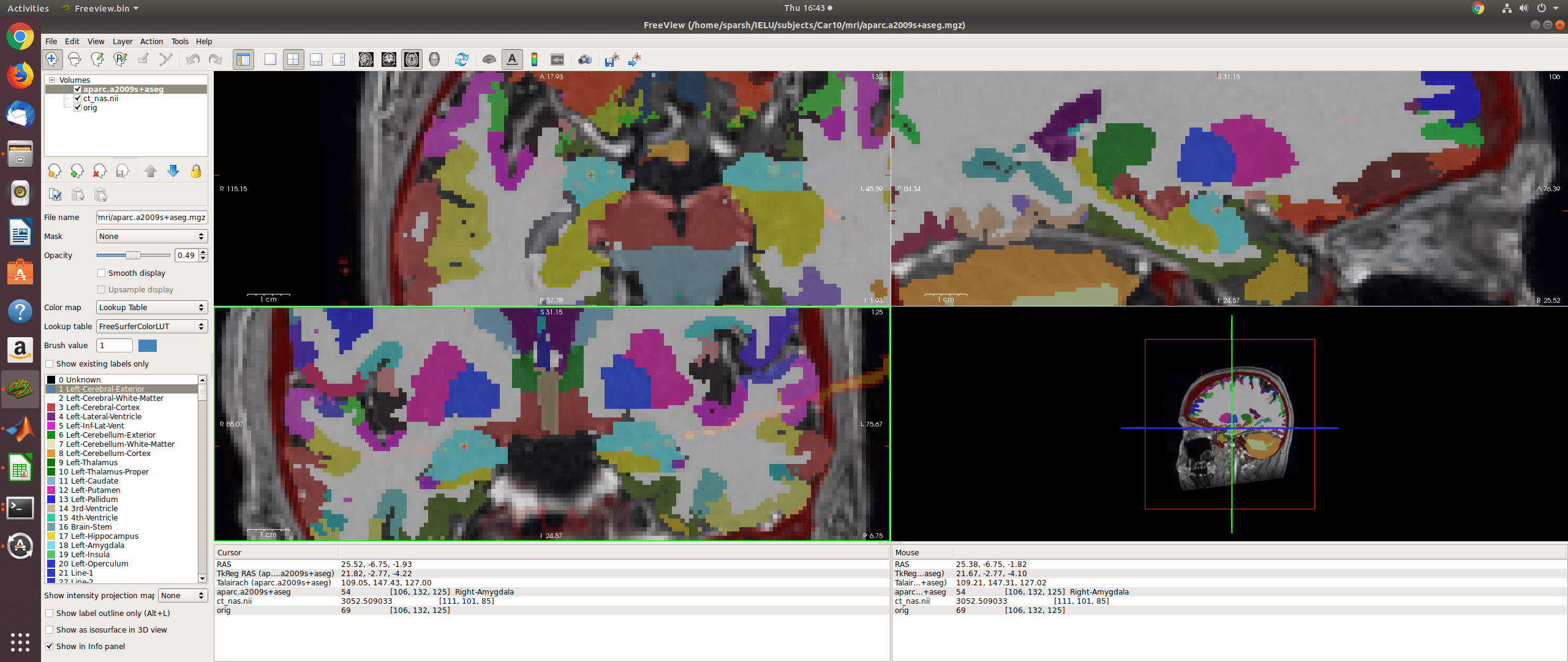
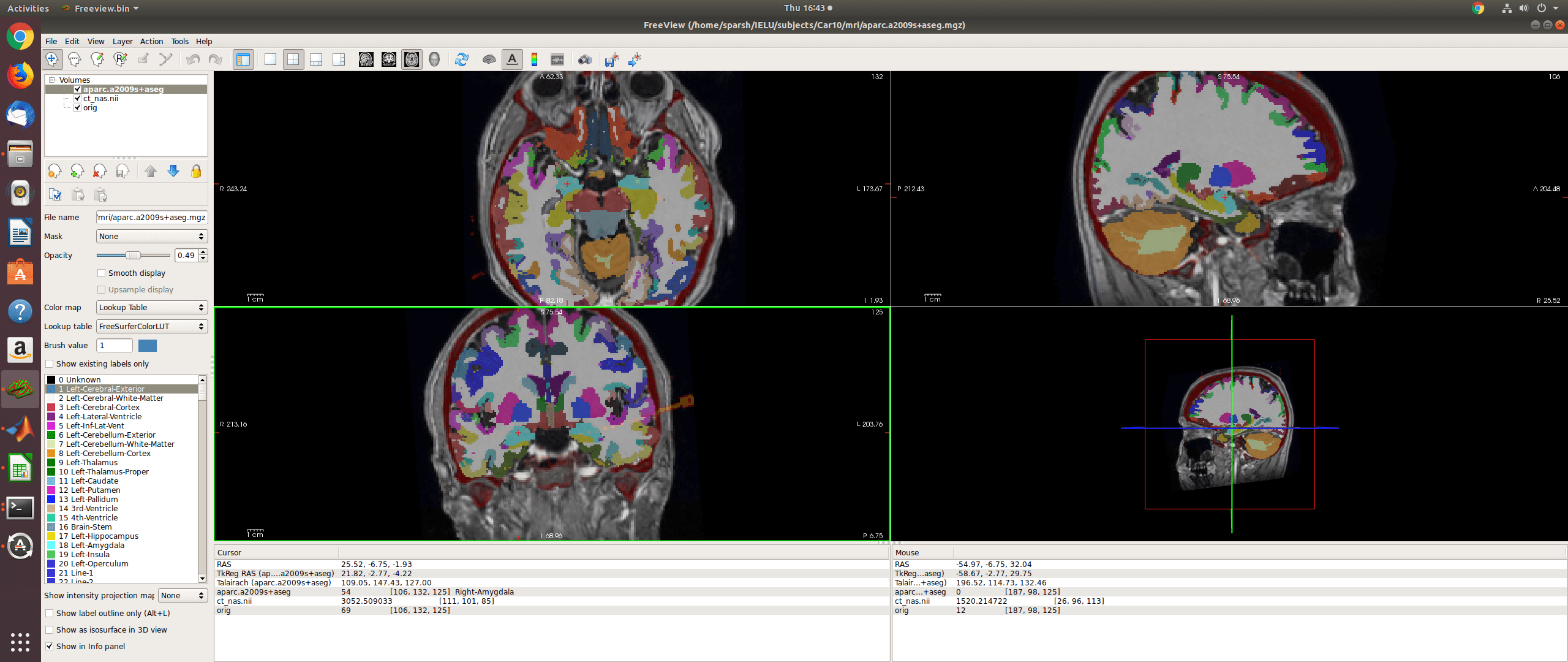
Is that point labeled as WM in the aseg? If so, then it is not a problem with matlab:)
On 3/7/19 5:58 PM, Sparsh Jain wrote:
External Email - Use Caution
Thanks a lot! It worked. While most of the labels were correct, the matlab script returned the wrong location for one point . The script returned the label 'right cerebral white matter' for a point that seems to lie in the middle of the right amygdala. I have attached the screenshots. I do not think that there is a white matter area close enough to confuse the script. Could you tell me why this may have occurred? When I write the line "crs = round(inv(aparcaseg.tkrvox2ras)*[tkr tka tks 1]')+1" , is there an error due to rounding in the conversion?
I was planning to inflate a sphere around each electrode point and get the neighboring anatomical regions as well.
Sparsh
On Thu, Feb 21, 2019 at 12:51 PM Greve, Douglas N.,Ph.D. <DGREVE@mgh.harvard.edu mailto:DGREVE@mgh.harvard.edu> wrote:
For a volume, I would do it differently. In matlab

[segcodes segnames ] = read_fscolorlut(); % read in the seg lookup
table

aparcaseg = MRIread('aparc+aseg.mgz'); % Load in the volume
crs = round(inv(aparcaseg.tkrvox2ras)*[tkr tka tks 1]')+1; % convert
your tkreg coords to col, row, and slice
c = crs(1);
r = crs(2);
s = crs(3);
segno = aparcaseg.vol(r,c,s); % extract the segmentation number
ind = find(segno == segcodes); % convert to the ne name of the
segmentation
segname = segnames(ind,:)


On 2/20/19 9:58 AM, Sparsh Jain wrote:
>
>         External Email - Use Caution
>
> Hi Doug,
>
> I tried what you suggested, but it did not work (see below for
details
> of what we tried). We have TkReg RAS coordinates (or vertex points)
> for our electrode contacts; most contacts are _deep within the
> brain_ (e.g., hippocampus and amygdala). We want to get a
variable in
> Matlab that will give us the anatomical labels as a function of the
> TkReg RAS coordinates (or vertex points). How can we do this?
>
> Thanks!
>
> Sparsh
>
> _What I tried:_ I read the 'rh.aparc.2009a.annot' file in matlab
using
> read_annotation.m. That gave me 76 labels for right hemisphere,
which
> I believe correspond to the surface parcellations only. In
freeview I
> loaded the orig.mgz, aparc.a2009s+aseg.mgz, rh.pial and
rh.inflated. I
> then clicked on a cortical surface point to see if I can get the
> corresponding vertex number or structure ID. On doing so, I found a
> value in the Vertex row under rh.pial of freeview but this number
> wasn't found in the matlab output (in the colortable.label or
> colortable.table). I think I am looking in the wrong place to
find the
> vertex # on freeview.
>
> Also, I did not find a readable file for the segmentation data. I
> tried to read the aparc.a2009s+aseg.mgz on Matlab but that
didn't work.
> Show quoted text
>
> On Thu, 7 Feb 2019, 16:10 Greve, Douglas N.,Ph.D.
> <DGREVE@mgh.harvard.edu <mailto:DGREVE@mgh.harvard.edu>
<mailto:DGREVE@mgh.harvard.edu <mailto:DGREVE@mgh.harvard.edu>> wrote:
>
>     First, you'll have to find the closest vertex for each point in
>     fsavarage. You can do this with by creating a label file
then using
>     mri_label2label with the --paint option.
>
>     To find the label associated with each vertex, it is  probably
>     easiest
>     to use matlab using read_surf.m and read_annotation.m
>
>     On 2/5/19 11:17 AM, Sparsh Jain wrote:
>     >
>     >         External Email - Use Caution
>     >
>     > Good afternoon
>     >
>     > Is there is way to automatically extract the anatomical
locations
>     > corresponding to a set of RAS coordinates using Freesurfer's
>     atlas? I
>     > have a set of 200 points and I am trying to get their
anatomical
>     > labels automatically.
>     >
>     > Thank you
>     > Sparsh
>     >
>     > _______________________________________________
>     > Freesurfer mailing list
>     > Freesurfer@nmr.mgh.harvard.edu
<mailto:Freesurfer@nmr.mgh.harvard.edu>
>     <mailto:Freesurfer@nmr.mgh.harvard.edu
<mailto:Freesurfer@nmr.mgh.harvard.edu>>
>     > https://mail.nmr.mgh.harvard.edu/mailman/listinfo/freesurfer
>
>
>     _______________________________________________
>     Freesurfer mailing list
> Freesurfer@nmr.mgh.harvard.edu
<mailto:Freesurfer@nmr.mgh.harvard.edu>
<mailto:Freesurfer@nmr.mgh.harvard.edu
<mailto:Freesurfer@nmr.mgh.harvard.edu>>
> https://mail.nmr.mgh.harvard.edu/mailman/listinfo/freesurfer
>
>
> _______________________________________________
> Freesurfer mailing list
> Freesurfer@nmr.mgh.harvard.edu
<mailto:Freesurfer@nmr.mgh.harvard.edu>
> https://mail.nmr.mgh.harvard.edu/mailman/listinfo/freesurfer


_______________________________________________
Freesurfer mailing list
Freesurfer@nmr.mgh.harvard.edu <mailto:Freesurfer@nmr.mgh.harvard.edu>
https://mail.nmr.mgh.harvard.edu/mailman/listinfo/freesurfer
Freesurfer mailing list Freesurfer@nmr.mgh.harvard.edu https://mail.nmr.mgh.harvard.edu/mailman/listinfo/freesurfer
External Email - Use Caution
I see. How may I check that?
Sparsh
On Thu, Mar 7, 2019 at 6:42 PM Greve, Douglas N.,Ph.D. < DGREVE@mgh.harvard.edu> wrote:
Is that point labeled as WM in the aseg? If so, then it is not a problem with matlab:)
On 3/7/19 5:58 PM, Sparsh Jain wrote:
External Email - Use CautionThanks a lot! It worked. While most of the labels were correct, the matlab script returned the wrong location for one point . The script returned the label 'right cerebral white matter' for a point that seems to lie in the middle of the right amygdala. I have attached the screenshots. I do not think that there is a white matter area close enough to confuse the script. Could you tell me why this may have occurred? When I write the line "crs = round(inv(aparcaseg.tkrvox2ras)*[tkr tka tks 1]')+1" , is there an error due to rounding in the conversion?
I was planning to inflate a sphere around each electrode point and get the neighboring anatomical regions as well.
Sparsh
On Thu, Feb 21, 2019 at 12:51 PM Greve, Douglas N.,Ph.D. <DGREVE@mgh.harvard.edu mailto:DGREVE@mgh.harvard.edu> wrote:
For a volume, I would do it differently. In matlab

[segcodes segnames ] = read_fscolorlut(); % read in the seg lookup
table

aparcaseg = MRIread('aparc+aseg.mgz'); % Load in the volume
crs = round(inv(aparcaseg.tkrvox2ras)*[tkr tka tks 1]')+1; % convert
your tkreg coords to col, row, and slice
c = crs(1);
r = crs(2);
s = crs(3);
segno = aparcaseg.vol(r,c,s); % extract the segmentation number
ind = find(segno == segcodes); % convert to the ne name of the
segmentation
segname = segnames(ind,:)


On 2/20/19 9:58 AM, Sparsh Jain wrote:
>
>         External Email - Use Caution
>
> Hi Doug,
>
> I tried what you suggested, but it did not work (see below for
details
> of what we tried). We have TkReg RAS coordinates (or vertex points)
> for our electrode contacts; most contacts are _deep within the
> brain_ (e.g., hippocampus and amygdala). We want to get a
variable in
> Matlab that will give us the anatomical labels as a function of the
> TkReg RAS coordinates (or vertex points). How can we do this?
>
> Thanks!
>
> Sparsh
>
> _What I tried:_ I read the 'rh.aparc.2009a.annot' file in matlab
using
> read_annotation.m. That gave me 76 labels for right hemisphere,
which
> I believe correspond to the surface parcellations only. In
freeview I
> loaded the orig.mgz, aparc.a2009s+aseg.mgz, rh.pial and
rh.inflated. I
> then clicked on a cortical surface point to see if I can get the
> corresponding vertex number or structure ID. On doing so, I found a
> value in the Vertex row under rh.pial of freeview but this number
> wasn't found in the matlab output (in the colortable.label or
> colortable.table). I think I am looking in the wrong place to
find the
> vertex # on freeview.
>
> Also, I did not find a readable file for the segmentation data. I
> tried to read the aparc.a2009s+aseg.mgz on Matlab but that
didn't work.
> Show quoted text
>
> On Thu, 7 Feb 2019, 16:10 Greve, Douglas N.,Ph.D.
> <DGREVE@mgh.harvard.edu <mailto:DGREVE@mgh.harvard.edu>
<mailto:DGREVE@mgh.harvard.edu <mailto:DGREVE@mgh.harvard.edu>>
wrote:
>
>     First, you'll have to find the closest vertex for each point in
>     fsavarage. You can do this with by creating a label file
then using
>     mri_label2label with the --paint option.
>
>     To find the label associated with each vertex, it is  probably
>     easiest
>     to use matlab using read_surf.m and read_annotation.m
>
>     On 2/5/19 11:17 AM, Sparsh Jain wrote:
>     >
>     >         External Email - Use Caution
>     >
>     > Good afternoon
>     >
>     > Is there is way to automatically extract the anatomical
locations
>     > corresponding to a set of RAS coordinates using Freesurfer's
>     atlas? I
>     > have a set of 200 points and I am trying to get their
anatomical
>     > labels automatically.
>     >
>     > Thank you
>     > Sparsh
>     >
>     > _______________________________________________
>     > Freesurfer mailing list
>     > Freesurfer@nmr.mgh.harvard.edu
<mailto:Freesurfer@nmr.mgh.harvard.edu>
>     <mailto:Freesurfer@nmr.mgh.harvard.edu
<mailto:Freesurfer@nmr.mgh.harvard.edu>>
>     > https://mail.nmr.mgh.harvard.edu/mailman/listinfo/freesurfer
>
>
>     _______________________________________________
>     Freesurfer mailing list
> Freesurfer@nmr.mgh.harvard.edu
<mailto:Freesurfer@nmr.mgh.harvard.edu>
<mailto:Freesurfer@nmr.mgh.harvard.edu
<mailto:Freesurfer@nmr.mgh.harvard.edu>>
> https://mail.nmr.mgh.harvard.edu/mailman/listinfo/freesurfer
>
>
> _______________________________________________
> Freesurfer mailing list
> Freesurfer@nmr.mgh.harvard.edu
<mailto:Freesurfer@nmr.mgh.harvard.edu>
> https://mail.nmr.mgh.harvard.edu/mailman/listinfo/freesurfer


_______________________________________________
Freesurfer mailing list
Freesurfer@nmr.mgh.harvard.edu <mailto:
Freesurfer@nmr.mgh.harvard.edu>
https://mail.nmr.mgh.harvard.edu/mailman/listinfo/freesurfer
Freesurfer mailing list Freesurfer@nmr.mgh.harvard.edu https://mail.nmr.mgh.harvard.edu/mailman/listinfo/freesurfer
Freesurfer mailing list Freesurfer@nmr.mgh.harvard.edu https://mail.nmr.mgh.harvard.edu/mailman/listinfo/freesurfer

External Email - Use Caution
You could load the aseg in freeview and navigate to the voxel (you can enter the CRS at the bottom, no need to scroll there). Then you have its intensity value, which you can check against FreeSurferColorLUT.txt.
Tim
-- Dr. Tim Schäfer Postdoc Computational Neuroimaging Department of Child and Adolescent Psychiatry, Psychosomatics and Psychotherapy University Hospital Frankfurt, Goethe University Frankfurt am Main, Germany
On March 8, 2019 at 12:55 AM Sparsh Jain sparshj@vt.edu wrote:
External Email - Use CautionI see. How may I check that?
Sparsh
On Thu, Mar 7, 2019 at 6:42 PM Greve, Douglas N.,Ph.D. < DGREVE@mgh.harvard.edu> wrote:
Is that point labeled as WM in the aseg? If so, then it is not a problem with matlab:)
On 3/7/19 5:58 PM, Sparsh Jain wrote:
External Email - Use CautionThanks a lot! It worked. While most of the labels were correct, the matlab script returned the wrong location for one point . The script returned the label 'right cerebral white matter' for a point that seems to lie in the middle of the right amygdala. I have attached the screenshots. I do not think that there is a white matter area close enough to confuse the script. Could you tell me why this may have occurred? When I write the line "crs = round(inv(aparcaseg.tkrvox2ras)*[tkr tka tks 1]')+1" , is there an error due to rounding in the conversion?
I was planning to inflate a sphere around each electrode point and get the neighboring anatomical regions as well.
Sparsh
On Thu, Feb 21, 2019 at 12:51 PM Greve, Douglas N.,Ph.D. <DGREVE@mgh.harvard.edu mailto:DGREVE@mgh.harvard.edu> wrote:
For a volume, I would do it differently. In matlab

[segcodes segnames ] = read_fscolorlut(); % read in the seg lookup
table

aparcaseg = MRIread('aparc+aseg.mgz'); % Load in the volume
crs = round(inv(aparcaseg.tkrvox2ras)*[tkr tka tks 1]')+1; % convert
your tkreg coords to col, row, and slice
c = crs(1);
r = crs(2);
s = crs(3);
segno = aparcaseg.vol(r,c,s); % extract the segmentation number
ind = find(segno == segcodes); % convert to the ne name of the
segmentation
segname = segnames(ind,:)


On 2/20/19 9:58 AM, Sparsh Jain wrote:
>
>         External Email - Use Caution
>
> Hi Doug,
>
> I tried what you suggested, but it did not work (see below for
details
> of what we tried). We have TkReg RAS coordinates (or vertex points)
> for our electrode contacts; most contacts are _deep within the
> brain_ (e.g., hippocampus and amygdala). We want to get a
variable in
> Matlab that will give us the anatomical labels as a function of the
> TkReg RAS coordinates (or vertex points). How can we do this?
>
> Thanks!
>
> Sparsh
>
> _What I tried:_ I read the 'rh.aparc.2009a.annot' file in matlab
using
> read_annotation.m. That gave me 76 labels for right hemisphere,
which
> I believe correspond to the surface parcellations only. In
freeview I
> loaded the orig.mgz, aparc.a2009s+aseg.mgz, rh.pial and
rh.inflated. I
> then clicked on a cortical surface point to see if I can get the
> corresponding vertex number or structure ID. On doing so, I found a
> value in the Vertex row under rh.pial of freeview but this number
> wasn't found in the matlab output (in the colortable.label or
> colortable.table). I think I am looking in the wrong place to
find the
> vertex # on freeview.
>
> Also, I did not find a readable file for the segmentation data. I
> tried to read the aparc.a2009s+aseg.mgz on Matlab but that
didn't work.
> Show quoted text
>
> On Thu, 7 Feb 2019, 16:10 Greve, Douglas N.,Ph.D.
> <DGREVE@mgh.harvard.edu <mailto:DGREVE@mgh.harvard.edu>
<mailto:DGREVE@mgh.harvard.edu <mailto:DGREVE@mgh.harvard.edu>>
wrote:
>
>     First, you'll have to find the closest vertex for each point in
>     fsavarage. You can do this with by creating a label file
then using
>     mri_label2label with the --paint option.
>
>     To find the label associated with each vertex, it is  probably
>     easiest
>     to use matlab using read_surf.m and read_annotation.m
>
>     On 2/5/19 11:17 AM, Sparsh Jain wrote:
>     >
>     >         External Email - Use Caution
>     >
>     > Good afternoon
>     >
>     > Is there is way to automatically extract the anatomical
locations
>     > corresponding to a set of RAS coordinates using Freesurfer's
>     atlas? I
>     > have a set of 200 points and I am trying to get their
anatomical
>     > labels automatically.
>     >
>     > Thank you
>     > Sparsh
>     >
>     > _______________________________________________
>     > Freesurfer mailing list
>     > Freesurfer@nmr.mgh.harvard.edu
<mailto:Freesurfer@nmr.mgh.harvard.edu>
>     <mailto:Freesurfer@nmr.mgh.harvard.edu
<mailto:Freesurfer@nmr.mgh.harvard.edu>>
>     > https://mail.nmr.mgh.harvard.edu/mailman/listinfo/freesurfer
>
>
>     _______________________________________________
>     Freesurfer mailing list
> Freesurfer@nmr.mgh.harvard.edu
<mailto:Freesurfer@nmr.mgh.harvard.edu>
<mailto:Freesurfer@nmr.mgh.harvard.edu
<mailto:Freesurfer@nmr.mgh.harvard.edu>>
> https://mail.nmr.mgh.harvard.edu/mailman/listinfo/freesurfer
>
>
> _______________________________________________
> Freesurfer mailing list
> Freesurfer@nmr.mgh.harvard.edu
<mailto:Freesurfer@nmr.mgh.harvard.edu>
> https://mail.nmr.mgh.harvard.edu/mailman/listinfo/freesurfer


_______________________________________________
Freesurfer mailing list
Freesurfer@nmr.mgh.harvard.edu <mailto:
Freesurfer@nmr.mgh.harvard.edu>
https://mail.nmr.mgh.harvard.edu/mailman/listinfo/freesurfer
Freesurfer mailing list Freesurfer@nmr.mgh.harvard.edu https://mail.nmr.mgh.harvard.edu/mailman/listinfo/freesurfer
Freesurfer mailing list Freesurfer@nmr.mgh.harvard.edu https://mail.nmr.mgh.harvard.edu/mailman/listinfo/freesurfer
Freesurfer mailing list Freesurfer@nmr.mgh.harvard.edu https://mail.nmr.mgh.harvard.edu/mailman/listinfo/freesurfer
External Email - Use Caution
Thank you. I loaded aseg and input the crs values. The aseg file gave an intensity value of 54 and the label as right amygdala! So it seems like the problem is not with the aseg file. Is there another possibility?
Sparsh
On Fri, Mar 8, 2019 at 3:00 AM Tim Schäfer ts+ml@rcmd.org wrote:
External Email - Use CautionYou could load the aseg in freeview and navigate to the voxel (you can enter the CRS at the bottom, no need to scroll there). Then you have its intensity value, which you can check against FreeSurferColorLUT.txt.
Tim
-- Dr. Tim Schäfer Postdoc Computational Neuroimaging Department of Child and Adolescent Psychiatry, Psychosomatics and Psychotherapy University Hospital Frankfurt, Goethe University Frankfurt am Main, Germany
On March 8, 2019 at 12:55 AM Sparsh Jain sparshj@vt.edu wrote:
External Email - Use CautionI see. How may I check that?
Sparsh
On Thu, Mar 7, 2019 at 6:42 PM Greve, Douglas N.,Ph.D. < DGREVE@mgh.harvard.edu> wrote:
Is that point labeled as WM in the aseg? If so, then it is not a
problem
with matlab:)
On 3/7/19 5:58 PM, Sparsh Jain wrote:
External Email - Use CautionThanks a lot! It worked. While most of the labels were correct, the matlab script returned the wrong location for one point . The script returned the label 'right cerebral white matter' for a point that seems to lie in the middle of the right amygdala. I have attached the screenshots. I do not think that there is a white matter area close enough to confuse the script. Could you tell me why this may have occurred? When I write the line "crs = round(inv(aparcaseg.tkrvox2ras)*[tkr tka tks 1]')+1" , is there an error due to rounding in the conversion?
I was planning to inflate a sphere around each electrode point and
get
the neighboring anatomical regions as well.
Sparsh
On Thu, Feb 21, 2019 at 12:51 PM Greve, Douglas N.,Ph.D. <DGREVE@mgh.harvard.edu mailto:DGREVE@mgh.harvard.edu> wrote:
For a volume, I would do it differently. In matlab

[segcodes segnames ] = read_fscolorlut(); % read in the seg
lookup
table

aparcaseg = MRIread('aparc+aseg.mgz'); % Load in the volume
crs = round(inv(aparcaseg.tkrvox2ras)*[tkr tka tks 1]')+1; %
convert
your tkreg coords to col, row, and slice
c = crs(1);
r = crs(2);
s = crs(3);
segno = aparcaseg.vol(r,c,s); % extract the segmentation number
ind = find(segno == segcodes); % convert to the ne name of the
segmentation
segname = segnames(ind,:)


On 2/20/19 9:58 AM, Sparsh Jain wrote:
>
>         External Email - Use Caution
>
> Hi Doug,
>
> I tried what you suggested, but it did not work (see below for
details
> of what we tried). We have TkReg RAS coordinates (or vertex
points)
> for our electrode contacts; most contacts are _deep within the
> brain_ (e.g., hippocampus and amygdala). We want to get a
variable in
> Matlab that will give us the anatomical labels as a function
of the
> TkReg RAS coordinates (or vertex points). How can we do this?
>
> Thanks!
>
> Sparsh
>
> _What I tried:_ I read the 'rh.aparc.2009a.annot' file in
matlab
using
> read_annotation.m. That gave me 76 labels for right hemisphere,
which
> I believe correspond to the surface parcellations only. In
freeview I
> loaded the orig.mgz, aparc.a2009s+aseg.mgz, rh.pial and
rh.inflated. I
> then clicked on a cortical surface point to see if I can get
the
> corresponding vertex number or structure ID. On doing so, Ifound a
> value in the Vertex row under rh.pial of freeview but thisnumber
> wasn't found in the matlab output (in the colortable.label or
> colortable.table). I think I am looking in the wrong place to
find the
> vertex # on freeview.
>
> Also, I did not find a readable file for the segmentation
data. I
> tried to read the aparc.a2009s+aseg.mgz on Matlab but that
didn't work.
> Show quoted text
>
> On Thu, 7 Feb 2019, 16:10 Greve, Douglas N.,Ph.D.
> <DGREVE@mgh.harvard.edu <mailto:DGREVE@mgh.harvard.edu>
<mailto:DGREVE@mgh.harvard.edu <mailto:DGREVE@mgh.harvard.edu>>
wrote:
>
>     First, you'll have to find the closest vertex for each
point in
>     fsavarage. You can do this with by creating a label file
then using
>     mri_label2label with the --paint option.
>
>     To find the label associated with each vertex, it is
probably
>     easiest
>     to use matlab using read_surf.m and read_annotation.m
>
>     On 2/5/19 11:17 AM, Sparsh Jain wrote:
>     >
>     >         External Email - Use Caution
>     >
>     > Good afternoon
>     >
>     > Is there is way to automatically extract the anatomical
locations
>     > corresponding to a set of RAS coordinates using
Freesurfer's
>     atlas? I
>     > have a set of 200 points and I am trying to get their
anatomical
>     > labels automatically.
>     >
>     > Thank you
>     > Sparsh
>     >
>     > _______________________________________________
>     > Freesurfer mailing list
>     > Freesurfer@nmr.mgh.harvard.edu
<mailto:Freesurfer@nmr.mgh.harvard.edu>
>     <mailto:Freesurfer@nmr.mgh.harvard.edu
<mailto:Freesurfer@nmr.mgh.harvard.edu>>
>     >
https://mail.nmr.mgh.harvard.edu/mailman/listinfo/freesurfer
>
>
>     _______________________________________________
>     Freesurfer mailing list
> Freesurfer@nmr.mgh.harvard.edu
<mailto:Freesurfer@nmr.mgh.harvard.edu>
<mailto:Freesurfer@nmr.mgh.harvard.edu
<mailto:Freesurfer@nmr.mgh.harvard.edu>>
> https://mail.nmr.mgh.harvard.edu/mailman/listinfo/freesurfer
>
>
> _______________________________________________
> Freesurfer mailing list
> Freesurfer@nmr.mgh.harvard.edu
<mailto:Freesurfer@nmr.mgh.harvard.edu>
> https://mail.nmr.mgh.harvard.edu/mailman/listinfo/freesurfer


_______________________________________________
Freesurfer mailing list
Freesurfer@nmr.mgh.harvard.edu <mailto:
Freesurfer@nmr.mgh.harvard.edu>
https://mail.nmr.mgh.harvard.edu/mailman/listinfo/freesurfer
Freesurfer mailing list Freesurfer@nmr.mgh.harvard.edu https://mail.nmr.mgh.harvard.edu/mailman/listinfo/freesurfer
Freesurfer mailing list Freesurfer@nmr.mgh.harvard.edu https://mail.nmr.mgh.harvard.edu/mailman/listinfo/freesurfer
Freesurfer mailing list Freesurfer@nmr.mgh.harvard.edu https://mail.nmr.mgh.harvard.edu/mailman/listinfo/freesurfer
Freesurfer mailing list Freesurfer@nmr.mgh.harvard.edu https://mail.nmr.mgh.harvard.edu/mailman/listinfo/freesurfer
freesurfer@nmr.mgh.harvard.edu
-
 Greve, Douglas N.,Ph.D.
 -
 Sparsh Jain
 -
 Tim Schäfer