
Dear experts,
I run my statistical analysis in SPM, while after coregistration I normalize my data (SPGR and EPI). Since my models and activations images are based on normalized data it's natural for me to use the normalized SPGR as an input for freesurfer inflation. Is it a good enough? Since I run inflation for each individual brain, I basically can do it for non-normalized anatomy, which is preferable, I think. However, then the coordinates are not MNI / Talariach. Attached the comparison of activations for normalized (left side) vs. non-normalized. It looks pretty similar, though the brains look of different shape. So, am I OK to do it on normalized brain?
Thanks for help, Vadim


Hi Vadim
the only problem will be that you've introduced an extra interpolation and the associated smoothing into your data. I suspect it will reduce the accuracy of the models for things like thickness estimation, but otherwise should be fine for e.g. functional overlaying.
cheers Bruce
On Mon, 29 Mar 2010, Vadim Axel wrote:
Dear experts,
I run my statistical analysis in SPM, while after coregistration I normalize my data (SPGR and EPI). Since my models and activations images are based on normalized data it's natural for me to use the normalized SPGR as an input for freesurfer inflation. Is it a good enough? Since I run inflation for each individual brain, I basically can do it for non-normalized anatomy, which is preferable, I think. However, then the coordinates are not MNI / Talariach. Attached the comparison of activations for normalized (left side) vs. non-normalized. It looks pretty similar, though the brains look of different shape. So, am I OK to do it on normalized brain?
Thanks for help, Vadim
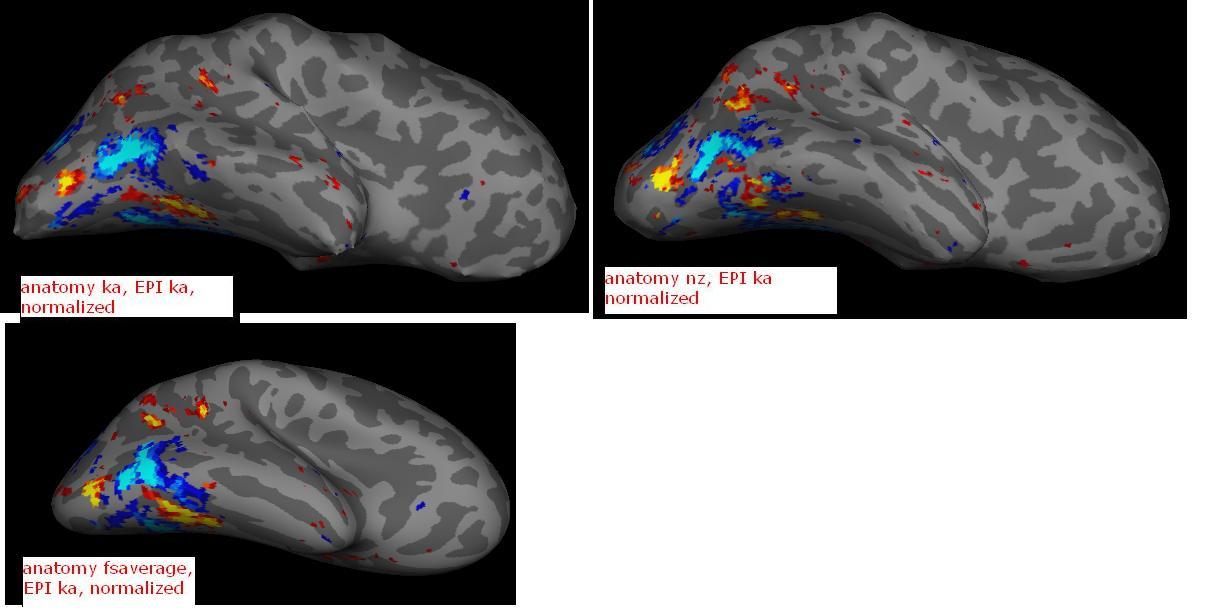
Thank you a lot, Bruce. One quick follow-up question: is it really bad is to project the activations on not_the_same_subject_anatomy? For example (attached), I have ran recon-all for two normalized SPGRs ('ka' and 'nz'). The general shape of brains is similar, though the sulci / gyri are in different places / form. Now I project the activations of one of them ('ka') to anatomies of itself and of 'nz'. The difference is dramatic. Does my demo make sense?
On Mon, Mar 29, 2010 at 2:42 PM, Bruce Fischl fischl@nmr.mgh.harvard.eduwrote:
Hi Vadim
the only problem will be that you've introduced an extra interpolation and the associated smoothing into your data. I suspect it will reduce the accuracy of the models for things like thickness estimation, but otherwise should be fine for e.g. functional overlaying.
cheers Bruce
On Mon, 29 Mar 2010, Vadim Axel wrote:
Dear experts,
I run my statistical analysis in SPM, while after coregistration I normalize my data (SPGR and EPI). Since my models and activations images are based on normalized data it's natural for me to use the normalized SPGR as an input for freesurfer inflation. Is it a good enough? Since I run inflation for each individual brain, I basically can do it for non-normalized anatomy, which is preferable, I think. However, then the coordinates are not MNI / Talariach. Attached the comparison of activations for normalized (left side) vs. non-normalized. It looks pretty similar, though the brains look of different shape. So, am I OK to do it on normalized brain?
Thanks for help, Vadim
The information in this e-mail is intended only for the person to whom it is addressed. If you believe this e-mail was sent to you in error and the e-mail contains patient information, please contact the Partners Compliance HelpLine at http://www.partners.org/complianceline . If the e-mail was sent to you in error but does not contain patient information, please contact the sender and properly dispose of the e-mail.
why would you do that? And how are you projecting? The best way to do it is to sample it onto the individual subject surface, then use mri_surf2surf to map from one to another?
On Mon, 29 Mar 2010, Vadim Axel wrote:
Thank you a lot, Bruce. One quick follow-up question: is it really bad is to project the activations on not_the_same_subject_anatomy? For example (attached), I have ran recon-all for two normalized SPGRs ('ka' and 'nz'). The general shape of brains is similar, though the sulci / gyri are in different places / form. Now I project the activations of one of them ('ka') to anatomies of itself and of 'nz'. The difference is dramatic. Does my demo make sense?
On Mon, Mar 29, 2010 at 2:42 PM, Bruce Fischl fischl@nmr.mgh.harvard.eduwrote:
Hi Vadim
the only problem will be that you've introduced an extra interpolation and the associated smoothing into your data. I suspect it will reduce the accuracy of the models for things like thickness estimation, but otherwise should be fine for e.g. functional overlaying.
cheers Bruce
On Mon, 29 Mar 2010, Vadim Axel wrote:
Dear experts,
I run my statistical analysis in SPM, while after coregistration I normalize my data (SPGR and EPI). Since my models and activations images are based on normalized data it's natural for me to use the normalized SPGR as an input for freesurfer inflation. Is it a good enough? Since I run inflation for each individual brain, I basically can do it for non-normalized anatomy, which is preferable, I think. However, then the coordinates are not MNI / Talariach. Attached the comparison of activations for normalized (left side) vs. non-normalized. It looks pretty similar, though the brains look of different shape. So, am I OK to do it on normalized brain?
Thanks for help, Vadim
The information in this e-mail is intended only for the person to whom it is addressed. If you believe this e-mail was sent to you in error and the e-mail contains patient information, please contact the Partners Compliance HelpLine at http://www.partners.org/complianceline . If the e-mail was sent to you in error but does not contain patient information, please contact the sender and properly dispose of the e-mail.
I just wanted to get a rough idea how my activations may look like before waiting 24h for reconstruction. But it looks like it's not a good idea even for rough idea.
I follow these instructions: http://132.183.202.158/fswiki/SpmPainting to view my functional data on the surface.
On Mon, Mar 29, 2010 at 4:07 PM, Bruce Fischl fischl@nmr.mgh.harvard.eduwrote:
why would you do that? And how are you projecting? The best way to do it is to sample it onto the individual subject surface, then use mri_surf2surf to map from one to another?
On Mon, 29 Mar 2010, Vadim Axel wrote:
Thank you a lot, Bruce.
One quick follow-up question: is it really bad is to project the activations on not_the_same_subject_anatomy? For example (attached), I have ran recon-all for two normalized SPGRs ('ka' and 'nz'). The general shape of brains is similar, though the sulci / gyri are in different places / form. Now I project the activations of one of them ('ka') to anatomies of itself and of 'nz'. The difference is dramatic. Does my demo make sense?
On Mon, Mar 29, 2010 at 2:42 PM, Bruce Fischl <fischl@nmr.mgh.harvard.edu
wrote:
Hi Vadim
the only problem will be that you've introduced an extra interpolation and the associated smoothing into your data. I suspect it will reduce the accuracy of the models for things like thickness estimation, but otherwise should be fine for e.g. functional overlaying.
cheers Bruce
On Mon, 29 Mar 2010, Vadim Axel wrote:
Dear experts,
I run my statistical analysis in SPM, while after coregistration I normalize my data (SPGR and EPI). Since my models and activations images are based on normalized data it's natural for me to use the normalized SPGR as an input for freesurfer inflation. Is it a good enough? Since I run inflation for each individual brain, I basically can do it for non-normalized anatomy, which is preferable, I think. However, then the coordinates are not MNI / Talariach. Attached the comparison of activations for normalized (left side) vs. non-normalized. It looks pretty similar, though the brains look of different shape. So, am I OK to do it on normalized brain?
Thanks for help, Vadim
The information in this e-mail is intended only for the person to whom it is addressed. If you believe this e-mail was sent to you in error and the e-mail contains patient information, please contact the Partners Compliance HelpLine at http://www.partners.org/complianceline . If the e-mail was sent to you in error but does not contain patient information, please contact the sender and properly dispose of the e-mail.
freesurfer@nmr.mgh.harvard.edu
-
 Bruce Fischl
 -
 Vadim Axel