
Hi All,
I'm having trouble reconciling the cluster colours with the graph that can be made when you load the group descriptor file and click on a point. I've attached an example.
In this study, I'm comparing thickness in a patient and control group, with age regressed out. The contrast I've used means that blue means control<patient. Therefore, patients are thicker than controls. But in the graph, patients don't seem to be thicker. I've seen the same results with red clusters (i.e. they should mean that controls are thicker but the graph shows otherwhise). Please let me know how I can interpret my findings given the graph. Which group is actually thicker?
Thank you, Allison
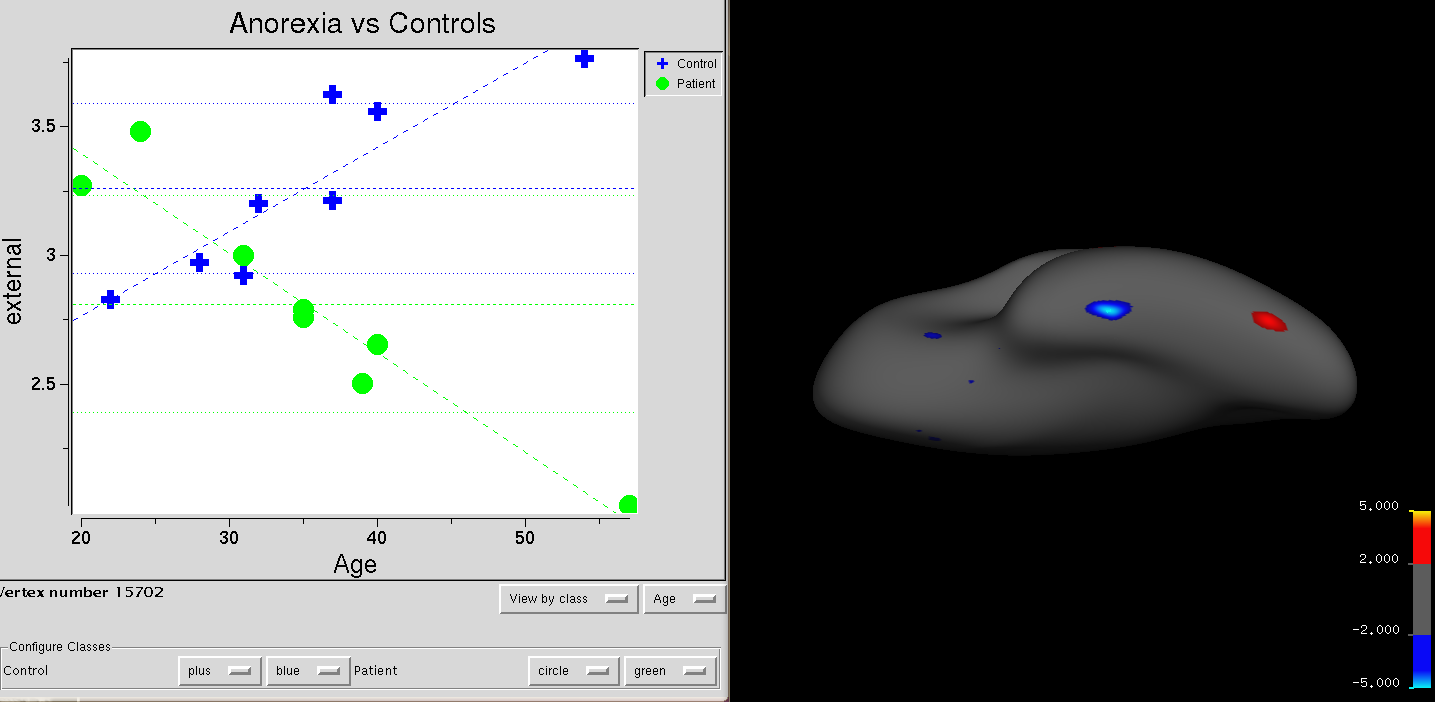

Allie, to be more precise, you have selected control<patient regressing out the effects of age. This second part is the key. If you were to trace the regression lines back to age=0 (the meaning of "regressing out age"), then control<patient by a wide margin. But you have a problem here in that the regression lines are crossed. This means that you have an interaction between age and patient (no interaction means that the lines would be parallel). An interaction means that you cannot assess whether there is a difference in the thickness because this difference changes depending upon the age. One thing you can try is to actually compute an interaction contrast (something like [0 0 1 -1]). If it is significant in this area, then there's not much you can do (though it may be interesting in itself). If it is not significant, then you can switch to a DOSS model which forces the lines to be parallel and makes the distance between the lines be independent of age. Does this make sense? doug
Allie Rosen wrote:
Hi All,
I'm having trouble reconciling the cluster colours with the graph that can be made when you load the group descriptor file and click on a point. I've attached an example.
In this study, I'm comparing thickness in a patient and control group, with age regressed out. The contrast I've used means that blue means control<patient. Therefore, patients are thicker than controls. But in the graph, patients don't seem to be thicker. I've seen the same results with red clusters (i.e. they should mean that controls are thicker but the graph shows otherwhise). Please let me know how I can interpret my findings given the graph. Which group is actually thicker?
Thank you, Allison
Freesurfer mailing list Freesurfer@nmr.mgh.harvard.edu https://mail.nmr.mgh.harvard.edu/mailman/listinfo/freesurfer
Hi Doug,
Thanks for the response. I've actually already run an interaction contrast and the same area is still significant (attached). I'm not sure how to interpret this either, unfortunately. Does it say that both groups are affected significantly differently by age? Can you tell me what it means? I'm having problems trying to do this myself.
Thanks very much, Allie
On Tue, Mar 6, 2012 at 3:47 PM, Douglas N Greve greve@nmr.mgh.harvard.eduwrote:
Allie, to be more precise, you have selected control<patient regressing out the effects of age. This second part is the key. If you were to trace the regression lines back to age=0 (the meaning of "regressing out age"), then control<patient by a wide margin. But you have a problem here in that the regression lines are crossed. This means that you have an interaction between age and patient (no interaction means that the lines would be parallel). An interaction means that you cannot assess whether there is a difference in the thickness because this difference changes depending upon the age. One thing you can try is to actually compute an interaction contrast (something like [0 0 1 -1]). If it is significant in this area, then there's not much you can do (though it may be interesting in itself). If it is not significant, then you can switch to a DOSS model which forces the lines to be parallel and makes the distance between the lines be independent of age. Does this make sense? doug
Allie Rosen wrote:
Hi All,
I'm having trouble reconciling the cluster colours with the graph that can be made when you load the group descriptor file and click on a point. I've attached an example. In this study, I'm comparing thickness in a patient and control group, with age regressed out. The contrast I've used means that blue means control<patient. Therefore, patients are thicker than controls. But in the graph, patients don't seem to be thicker. I've seen the same results with red clusters (i.e. they should mean that controls are thicker but the graph shows otherwhise). Please let me know how I can interpret my findings given the graph. Which group is actually thicker?
Thank you, Allison
------------------------------**------------------------------**
------------------------------**------------------------------**
______________________________**_________________ Freesurfer mailing list Freesurfer@nmr.mgh.harvard.edu https://mail.nmr.mgh.harvard.**edu/mailman/listinfo/**freesurferhttps://mail.nmr.mgh.harvard.edu/mailman/listinfo/freesurfer
-- Douglas N. Greve, Ph.D. MGH-NMR Center greve@nmr.mgh.harvard.edu Phone Number: 617-724-2358 Fax: 617-726-7422
Bugs: surfer.nmr.mgh.harvard.edu/**fswiki/BugReportinghttp://surfer.nmr.mgh.harvard.edu/fswiki/BugReporting FileDrop: www.nmr.mgh.harvard.edu/**facility/filedrop/index.htmlhttp://www.nmr.mgh.harvard.edu/facility/filedrop/index.html
The information in this e-mail is intended only for the person to whom it is addressed. If you believe this e-mail was sent to you in error and the e-mail contains patient information, please contact the Partners Compliance HelpLine at http://www.partners.org/**compliancelinehttp://www.partners.org/complianceline. If the e-mail was sent to you in error but does not contain patient information, please contact the sender and properly dispose of the e-mail.
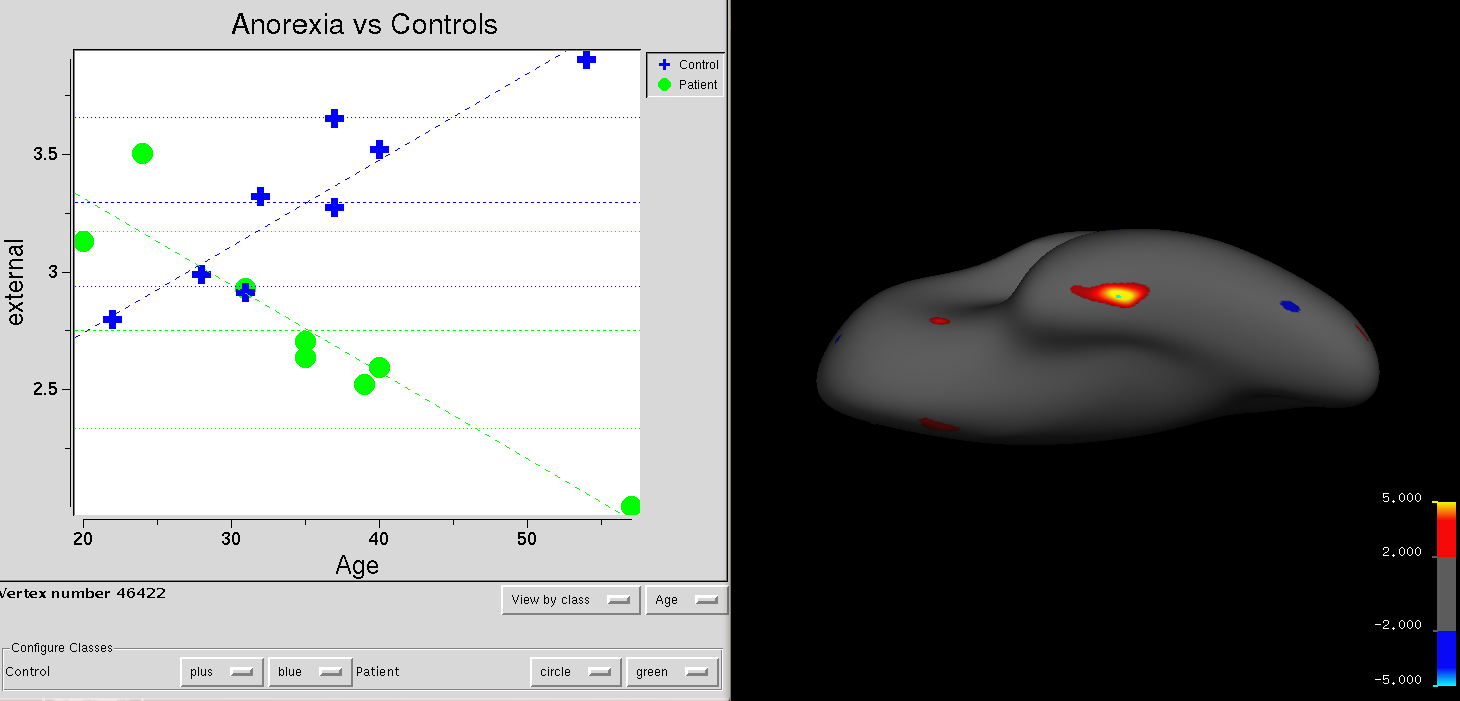
Hi Allie, yes, it means that each group is affected differently by age. The controls are increasing their thickness with age in this area (which seems strange, usually you expect general decreases with age). You might check the quality of the surfaces in this area. doug
Allie Rosen wrote:
Hi Doug,
Thanks for the response. I've actually already run an interaction contrast and the same area is still significant (attached). I'm not sure how to interpret this either, unfortunately. Does it say that both groups are affected significantly differently by age? Can you tell me what it means? I'm having problems trying to do this myself.
Thanks very much, Allie
On Tue, Mar 6, 2012 at 3:47 PM, Douglas N Greve <greve@nmr.mgh.harvard.edu mailto:greve@nmr.mgh.harvard.edu> wrote:
Allie, to be more precise, you have selected control<patient
regressing out the effects of age. This second part is the key.
 If you were to trace the regression lines back to age=0 (the
meaning of "regressing out age"), then control<patient by a wide
margin. But you have a problem here in that the regression lines
are crossed. This means that you have an interaction between age
and patient (no interaction means that the lines would be
parallel). An interaction means that you cannot assess whether
there is a difference in the thickness because this difference
changes depending upon the age. One thing you can try is to
actually compute an interaction contrast (something like [0 0 1
-1]). If it is significant in this area, then there's not much you
can do (though it may be interesting in itself). If it is not
significant, then you can switch to a DOSS model which forces the
lines to be parallel and makes the distance between the lines be
independent of age. Does this make sense?
doug


Allie Rosen wrote:

    Hi All,

    I'm having trouble reconciling the cluster colours with the
    graph that can be made when you load the group descriptor file
    and click on a point. I've attached an example.
    In this study, I'm comparing thickness in a patient and
    control group, with age regressed out. The contrast I've used
    means that blue means control<patient. Therefore, patients are
    thicker than controls. But in the graph, patients don't seem
    to be thicker. I've seen the same results with red clusters
    (i.e. they should mean that controls are thicker but the graph
    shows otherwhise). Please let me know how I can interpret my
    findings given the graph. Which group is actually thicker?

    Thank you,
    Allison

    ------------------------------------------------------------------------

    ------------------------------------------------------------------------

    _______________________________________________
    Freesurfer mailing list
    Freesurfer@nmr.mgh.harvard.edu
    <mailto:Freesurfer@nmr.mgh.harvard.edu>
    https://mail.nmr.mgh.harvard.edu/mailman/listinfo/freesurfer


--
Douglas N. Greve, Ph.D.
MGH-NMR Center
greve@nmr.mgh.harvard.edu <mailto:greve@nmr.mgh.harvard.edu>
Phone Number: 617-724-2358 <tel:617-724-2358> Fax: 617-726-7422
<tel:617-726-7422>

Bugs: surfer.nmr.mgh.harvard.edu/fswiki/BugReporting
<http://surfer.nmr.mgh.harvard.edu/fswiki/BugReporting>
FileDrop: www.nmr.mgh.harvard.edu/facility/filedrop/index.html
<http://www.nmr.mgh.harvard.edu/facility/filedrop/index.html>


The information in this e-mail is intended only for the person to
whom it is
addressed. If you believe this e-mail was sent to you in error and
the e-mail
contains patient information, please contact the Partners
Compliance HelpLine at
http://www.partners.org/complianceline . If the e-mail was sent to
you in error
but does not contain patient information, please contact the
sender and properly
dispose of the e-mail.
Hi Doug,
Yes, I think there actually may be a topologic defect in this area, although not directly where the cluster is (attached). Could this be the cause of the thickness result? If I go back and try to repair the defect, will that make the results more typical and, more importantly, correct?
Thanks again, Allie
On Tue, Mar 6, 2012 at 3:57 PM, Douglas N Greve greve@nmr.mgh.harvard.eduwrote:
Hi Allie, yes, it means that each group is affected differently by age. The controls are increasing their thickness with age in this area (which seems strange, usually you expect general decreases with age). You might check the quality of the surfaces in this area. doug
Allie Rosen wrote:
Hi Doug,
Thanks for the response. I've actually already run an interaction contrast and the same area is still significant (attached). I'm not sure how to interpret this either, unfortunately. Does it say that both groups are affected significantly differently by age? Can you tell me what it means? I'm having problems trying to do this myself.
Thanks very much, Allie
On Tue, Mar 6, 2012 at 3:47 PM, Douglas N Greve < greve@nmr.mgh.harvard.edu <mailto:greve@nmr.mgh.harvard.**edugreve@nmr.mgh.harvard.edu>> wrote:
Allie, to be more precise, you have selected control<patient regressing out the effects of age. This second part is the key. If you were to trace the regression lines back to age=0 (the meaning of "regressing out age"), then control<patient by a wide margin. But you have a problem here in that the regression lines are crossed. This means that you have an interaction between age and patient (no interaction means that the lines would be parallel). An interaction means that you cannot assess whether there is a difference in the thickness because this difference changes depending upon the age. One thing you can try is to actually compute an interaction contrast (something like [0 0 1 -1]). If it is significant in this area, then there's not much you can do (though it may be interesting in itself). If it is not significant, then you can switch to a DOSS model which forces the lines to be parallel and makes the distance between the lines be independent of age. Does this make sense? doug
Allie Rosen wrote:
   Hi All,

   I'm having trouble reconciling the cluster colours with the
   graph that can be made when you load the group descriptor file
   and click on a point. I've attached an example.
   In this study, I'm comparing thickness in a patient and
   control group, with age regressed out. The contrast I've used
   means that blue means control<patient. Therefore, patients are
   thicker than controls. But in the graph, patients don't seem
   to be thicker. I've seen the same results with red clusters
   (i.e. they should mean that controls are thicker but the graph
   shows otherwhise). Please let me know how I can interpret my
   findings given the graph. Which group is actually thicker?

   Thank you,
   Allison

   ------------------------------**------------------------------**
------------------------------**------------------------------**
______________________________**_________________ Freesurfer mailing list Freesurfer@nmr.mgh.harvard.edu <mailto:Freesurfer@nmr.mgh.**harvard.edu<Freesurfer@nmr.mgh.harvard.edu>https://mail.nmr.mgh.harvard.**edu/mailman/listinfo/**freesurfer<https://mail.nmr.mgh.harvard.edu/mailman/listinfo/freesurfer>-- Douglas N. Greve, Ph.D. MGH-NMR Center greve@nmr.mgh.harvard.edu <mailto:greve@nmr.mgh.harvard.**edugreve@nmr.mgh.harvard.edu
Phone Number: 617-724-2358 tel:617-724-2358 Fax: 617-726-7422 tel:617-726-7422
Bugs: surfer.nmr.mgh.harvard.edu/**fswiki/BugReportinghttp://surfer.nmr.mgh.harvard.edu/fswiki/BugReporting <http://surfer.nmr.mgh.**harvard.edu/fswiki/**BugReportinghttp://surfer.nmr.mgh.harvard.edu/fswiki/BugReporting
FileDrop: www.nmr.mgh.harvard.edu/**facility/filedrop/index.htmlhttp://www.nmr.mgh.harvard.edu/facility/filedrop/index.html <http://www.nmr.mgh.harvard.**edu/facility/filedrop/index.**htmlhttp://www.nmr.mgh.harvard.edu/facility/filedrop/index.html
The information in this e-mail is intended only for the person to whom it is addressed. If you believe this e-mail was sent to you in error and the e-mail contains patient information, please contact the Partners Compliance HelpLine at http://www.partners.org/**compliancelinehttp://www.partners.org/complianceline. If the e-mail was sent to you in error but does not contain patient information, please contact the sender and properly dispose of the e-mail.
------------------------------**------------------------------**
-- Douglas N. Greve, Ph.D. MGH-NMR Center greve@nmr.mgh.harvard.edu Phone Number: 617-724-2358 Fax: 617-726-7422
Bugs: surfer.nmr.mgh.harvard.edu/**fswiki/BugReportinghttp://surfer.nmr.mgh.harvard.edu/fswiki/BugReporting FileDrop: www.nmr.mgh.harvard.edu/**facility/filedrop/index.htmlhttp://www.nmr.mgh.harvard.edu/facility/filedrop/index.html
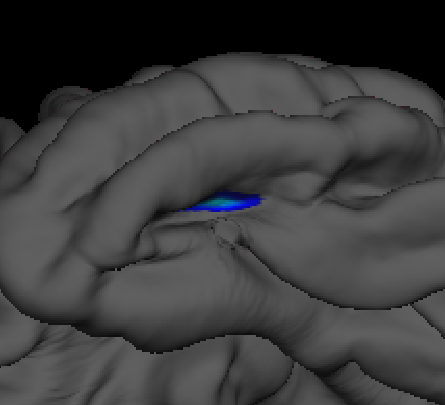
If this makes sense, there aren't any topological defects in the regions of other similar results.
On Tue, Mar 6, 2012 at 4:05 PM, Allie Rosen rosen.allie@gmail.com wrote:
Hi Doug,
Yes, I think there actually may be a topologic defect in this area, although not directly where the cluster is (attached). Could this be the cause of the thickness result? If I go back and try to repair the defect, will that make the results more typical and, more importantly, correct?
Thanks again, Allie
On Tue, Mar 6, 2012 at 3:57 PM, Douglas N Greve <greve@nmr.mgh.harvard.edu
wrote:
Hi Allie, yes, it means that each group is affected differently by age. The controls are increasing their thickness with age in this area (which seems strange, usually you expect general decreases with age). You might check the quality of the surfaces in this area. doug
Allie Rosen wrote:
Hi Doug,
Thanks for the response. I've actually already run an interaction contrast and the same area is still significant (attached). I'm not sure how to interpret this either, unfortunately. Does it say that both groups are affected significantly differently by age? Can you tell me what it means? I'm having problems trying to do this myself.
Thanks very much, Allie
On Tue, Mar 6, 2012 at 3:47 PM, Douglas N Greve < greve@nmr.mgh.harvard.edu <mailto:greve@nmr.mgh.harvard.**edugreve@nmr.mgh.harvard.edu>> wrote:
Allie, to be more precise, you have selected control<patient regressing out the effects of age. This second part is the key. If you were to trace the regression lines back to age=0 (the meaning of "regressing out age"), then control<patient by a wide margin. But you have a problem here in that the regression lines are crossed. This means that you have an interaction between age and patient (no interaction means that the lines would be parallel). An interaction means that you cannot assess whether there is a difference in the thickness because this difference changes depending upon the age. One thing you can try is to actually compute an interaction contrast (something like [0 0 1 -1]). If it is significant in this area, then there's not much you can do (though it may be interesting in itself). If it is not significant, then you can switch to a DOSS model which forces the lines to be parallel and makes the distance between the lines be independent of age. Does this make sense? doug
Allie Rosen wrote:
   Hi All,

   I'm having trouble reconciling the cluster colours with the
   graph that can be made when you load the group descriptor file
   and click on a point. I've attached an example.
   In this study, I'm comparing thickness in a patient and
   control group, with age regressed out. The contrast I've used
   means that blue means control<patient. Therefore, patients are
   thicker than controls. But in the graph, patients don't seem
   to be thicker. I've seen the same results with red clusters
   (i.e. they should mean that controls are thicker but the graph
   shows otherwhise). Please let me know how I can interpret my
   findings given the graph. Which group is actually thicker?

   Thank you,
   Allison

   ------------------------------**------------------------------**
------------------------------**------------------------------**
______________________________**_________________ Freesurfer mailing list Freesurfer@nmr.mgh.harvard.edu <mailto:Freesurfer@nmr.mgh.**harvard.edu<Freesurfer@nmr.mgh.harvard.edu>https://mail.nmr.mgh.harvard.**edu/mailman/listinfo/**freesurfer<https://mail.nmr.mgh.harvard.edu/mailman/listinfo/freesurfer>-- Douglas N. Greve, Ph.D. MGH-NMR Center greve@nmr.mgh.harvard.edu <mailto:greve@nmr.mgh.harvard.**edugreve@nmr.mgh.harvard.edu
Phone Number: 617-724-2358 tel:617-724-2358 Fax: 617-726-7422 tel:617-726-7422
Bugs: surfer.nmr.mgh.harvard.edu/**fswiki/BugReportinghttp://surfer.nmr.mgh.harvard.edu/fswiki/BugReporting <http://surfer.nmr.mgh.**harvard.edu/fswiki/**BugReportinghttp://surfer.nmr.mgh.harvard.edu/fswiki/BugReporting
FileDrop: www.nmr.mgh.harvard.edu/**facility/filedrop/index.htmlhttp://www.nmr.mgh.harvard.edu/facility/filedrop/index.html <http://www.nmr.mgh.harvard.**edu/facility/filedrop/index.**htmlhttp://www.nmr.mgh.harvard.edu/facility/filedrop/index.html
The information in this e-mail is intended only for the person to whom it is addressed. If you believe this e-mail was sent to you in error and the e-mail contains patient information, please contact the Partners Compliance HelpLine at http://www.partners.org/**compliancelinehttp://www.partners.org/complianceline. If the e-mail was sent to you in error but does not contain patient information, please contact the sender and properly dispose of the e-mail.
------------------------------**------------------------------**
-- Douglas N. Greve, Ph.D. MGH-NMR Center greve@nmr.mgh.harvard.edu Phone Number: 617-724-2358 Fax: 617-726-7422
Bugs: surfer.nmr.mgh.harvard.edu/**fswiki/BugReportinghttp://surfer.nmr.mgh.harvard.edu/fswiki/BugReporting FileDrop: www.nmr.mgh.harvard.edu/**facility/filedrop/index.htmlhttp://www.nmr.mgh.harvard.edu/facility/filedrop/index.html
It might, don't know
Allie Rosen wrote:
Hi Doug,
Yes, I think there actually may be a topologic defect in this area, although not directly where the cluster is (attached). Could this be the cause of the thickness result? If I go back and try to repair the defect, will that make the results more typical and, more importantly, correct?
Thanks again, Allie
On Tue, Mar 6, 2012 at 3:57 PM, Douglas N Greve <greve@nmr.mgh.harvard.edu mailto:greve@nmr.mgh.harvard.edu> wrote:
Hi Allie, yes, it means that each group is affected differently by
age. The controls are increasing their thickness with age in this
area (which seems strange, usually you expect general decreases
with age). You might check the quality of the surfaces in this area.
doug

Allie Rosen wrote:

    Hi Doug,

    Thanks for the response. I've actually already run an
    interaction contrast and the same area is still significant
    (attached). I'm not sure how to interpret this either,
    unfortunately. Does it say that both groups are affected
    significantly differently by age? Can you tell me what it
    means? I'm having problems trying to do this myself.

    Thanks very much,
    Allie

    On Tue, Mar 6, 2012 at 3:47 PM, Douglas N Greve
    <greve@nmr.mgh.harvard.edu <mailto:greve@nmr.mgh.harvard.edu>
    <mailto:greve@nmr.mgh.harvard.edu
    <mailto:greve@nmr.mgh.harvard.edu>>> wrote:

       Allie, to be more precise, you have selected control<patient
       regressing out the effects of age. This second part is the key.
        If you were to trace the regression lines back to age=0 (the
       meaning of "regressing out age"), then control<patient by a
    wide
       margin. But you have a problem here in that the regression
    lines
       are crossed. This means that you have an interaction
    between age
       and patient (no interaction means that the lines would be
       parallel). An interaction means that you cannot assess whether
       there is a difference in the thickness because this difference
       changes depending upon the age. One thing you can try is to
       actually compute an interaction contrast (something like [0 0 1
       -1]). If it is significant in this area, then there's not
    much you
       can do (though it may be interesting in itself). If it is not
       significant, then you can switch to a DOSS model which
    forces the
       lines to be parallel and makes the distance between the
    lines be
       independent of age. Does this make sense?
       doug


       Allie Rosen wrote:

           Hi All,

           I'm having trouble reconciling the cluster colours with the
           graph that can be made when you load the group
    descriptor file
           and click on a point. I've attached an example.
           In this study, I'm comparing thickness in a patient and
           control group, with age regressed out. The contrast
    I've used
           means that blue means control<patient. Therefore,
    patients are
           thicker than controls. But in the graph, patients don't
    seem
           to be thicker. I've seen the same results with red clusters
           (i.e. they should mean that controls are thicker but
    the graph
           shows otherwhise). Please let me know how I can
    interpret my
           findings given the graph. Which group is actually thicker?

           Thank you,
           Allison


     ------------------------------------------------------------------------


     ------------------------------------------------------------------------

           _______________________________________________
           Freesurfer mailing list
           Freesurfer@nmr.mgh.harvard.edu
    <mailto:Freesurfer@nmr.mgh.harvard.edu>
           <mailto:Freesurfer@nmr.mgh.harvard.edu
    <mailto:Freesurfer@nmr.mgh.harvard.edu>>


     https://mail.nmr.mgh.harvard.edu/mailman/listinfo/freesurfer


       --     Douglas N. Greve, Ph.D.
       MGH-NMR Center
       greve@nmr.mgh.harvard.edu
    <mailto:greve@nmr.mgh.harvard.edu>
    <mailto:greve@nmr.mgh.harvard.edu
    <mailto:greve@nmr.mgh.harvard.edu>>
       Phone Number: 617-724-2358 <tel:617-724-2358>
    <tel:617-724-2358 <tel:617-724-2358>> Fax: 617-726-7422
    <tel:617-726-7422>
       <tel:617-726-7422 <tel:617-726-7422>>

       Bugs: surfer.nmr.mgh.harvard.edu/fswiki/BugReporting
    <http://surfer.nmr.mgh.harvard.edu/fswiki/BugReporting>
       <http://surfer.nmr.mgh.harvard.edu/fswiki/BugReporting>
       FileDrop:
    www.nmr.mgh.harvard.edu/facility/filedrop/index.html
    <http://www.nmr.mgh.harvard.edu/facility/filedrop/index.html>
       <http://www.nmr.mgh.harvard.edu/facility/filedrop/index.html>


       The information in this e-mail is intended only for the
    person to
       whom it is
       addressed. If you believe this e-mail was sent to you in
    error and
       the e-mail
       contains patient information, please contact the Partners
       Compliance HelpLine at
       http://www.partners.org/complianceline . If the e-mail was
    sent to
       you in error
       but does not contain patient information, please contact the
       sender and properly
       dispose of the e-mail.


    ------------------------------------------------------------------------


--
Douglas N. Greve, Ph.D.
MGH-NMR Center
greve@nmr.mgh.harvard.edu <mailto:greve@nmr.mgh.harvard.edu>
Phone Number: 617-724-2358 <tel:617-724-2358> Fax: 617-726-7422
<tel:617-726-7422>

Bugs: surfer.nmr.mgh.harvard.edu/fswiki/BugReporting
<http://surfer.nmr.mgh.harvard.edu/fswiki/BugReporting>
FileDrop: www.nmr.mgh.harvard.edu/facility/filedrop/index.html
<http://www.nmr.mgh.harvard.edu/facility/filedrop/index.html>
So if my findings show that each group ages differently, does that mean I can't compare them at all because I can't regress out age? Or is there some way of comparing the groups despite this difference in aging patterns?
Thanks again, Allie
On Tue, Mar 6, 2012 at 4:44 PM, Douglas N Greve greve@nmr.mgh.harvard.eduwrote:
It might, don't know
Allie Rosen wrote:
Hi Doug,
Yes, I think there actually may be a topologic defect in this area, although not directly where the cluster is (attached). Could this be the cause of the thickness result? If I go back and try to repair the defect, will that make the results more typical and, more importantly, correct?
Thanks again, Allie
On Tue, Mar 6, 2012 at 3:57 PM, Douglas N Greve < greve@nmr.mgh.harvard.edu <mailto:greve@nmr.mgh.harvard.**edugreve@nmr.mgh.harvard.edu>> wrote:
Hi Allie, yes, it means that each group is affected differently by age. The controls are increasing their thickness with age in this area (which seems strange, usually you expect general decreases with age). You might check the quality of the surfaces in this area. doug
Allie Rosen wrote:
Hi Doug, Thanks for the response. I've actually already run an interaction contrast and the same area is still significant (attached). I'm not sure how to interpret this either, unfortunately. Does it say that both groups are affected significantly differently by age? Can you tell me what it means? I'm having problems trying to do this myself. Thanks very much, Allie On Tue, Mar 6, 2012 at 3:47 PM, Douglas N Greve <greve@nmr.mgh.harvard.edu <mailto:greve@nmr.mgh.harvard.**edu<greve@nmr.mgh.harvard.edu><mailto:greve@nmr.mgh.harvard.**edu <greve@nmr.mgh.harvard.edu> <mailto:greve@nmr.mgh.harvard.**edu <greve@nmr.mgh.harvard.edu>>>>wrote:
      Allie, to be more precise, you have selected control<patient
      regressing out the effects of age. This second part is the key.
       If you were to trace the regression lines back to age=0 (the
      meaning of "regressing out age"), then control<patient by a
   wide
      margin. But you have a problem here in that the regression
   lines
      are crossed. This means that you have an interaction
   between age
      and patient (no interaction means that the lines would be
      parallel). An interaction means that you cannot assess whether
      there is a difference in the thickness because this difference
      changes depending upon the age. One thing you can try is to
      actually compute an interaction contrast (something like [0 0 1
      -1]). If it is significant in this area, then there's not
   much you
      can do (though it may be interesting in itself). If it is not
      significant, then you can switch to a DOSS model which
   forces the
      lines to be parallel and makes the distance between the
   lines be
      independent of age. Does this make sense?
      doug


      Allie Rosen wrote:

          Hi All,

          I'm having trouble reconciling the cluster colours with the
          graph that can be made when you load the group
   descriptor file
          and click on a point. I've attached an example.
          In this study, I'm comparing thickness in a patient and
          control group, with age regressed out. The contrast
   I've used
          means that blue means control<patient. Therefore,
   patients are
          thicker than controls. But in the graph, patients don't
   seem
          to be thicker. I've seen the same results with red clusters
          (i.e. they should mean that controls are thicker but
   the graph
          shows otherwhise). Please let me know how I can
   interpret my
          findings given the graph. Which group is actually thicker?

          Thank you,
          Allison

                 ------------------------------**
------------------------------**------------
------------------------------**------------------------------**------------
______________________________**_________________ Freesurfer mailing list Freesurfer@nmr.mgh.harvard.edu <mailto:Freesurfer@nmr.mgh.**harvard.edu<Freesurfer@nmr.mgh.harvard.edu><mailto:Freesurfer@nmr.mgh.**harvard.edu<Freesurfer@nmr.mgh.harvard.edu> <mailto:Freesurfer@nmr.mgh.**harvard.edu<Freesurfer@nmr.mgh.harvard.edu>https://mail.nmr.mgh.harvard.**edu/mailman/listinfo/**freesurferhttps://mail.nmr.mgh.harvard.edu/mailman/listinfo/freesurfer
-- Douglas N. Greve, Ph.D. MGH-NMR Center greve@nmr.mgh.harvard.edu <mailto:greve@nmr.mgh.harvard.**edu <greve@nmr.mgh.harvard.edu>> <mailto:greve@nmr.mgh.harvard.**edu <greve@nmr.mgh.harvard.edu> <mailto:greve@nmr.mgh.harvard.**edu <greve@nmr.mgh.harvard.edu>>> Phone Number: 617-724-2358 <tel:617-724-2358> <tel:617-724-2358 <tel:617-724-2358>> Fax: 617-726-7422 <tel:617-726-7422> <tel:617-726-7422 <tel:617-726-7422>> Bugs: surfer.nmr.mgh.harvard.edu/**fswiki/BugReporting<http://surfer.nmr.mgh.harvard.edu/fswiki/BugReporting> <http://surfer.nmr.mgh.**harvard.edu/fswiki/**BugReporting<http://surfer.nmr.mgh.harvard.edu/fswiki/BugReporting><http://surfer.nmr.mgh.**harvard.edu/fswiki/**BugReporting<http://surfer.nmr.mgh.harvard.edu/fswiki/BugReporting>FileDrop: www.nmr.mgh.harvard.edu/**facility/filedrop/index.html<http://www.nmr.mgh.harvard.edu/facility/filedrop/index.html> <http://www.nmr.mgh.harvard.**edu/facility/filedrop/index.**html<http://www.nmr.mgh.harvard.edu/facility/filedrop/index.html><http://www.nmr.mgh.harvard.**edu/facility/filedrop/index.**html http://www.nmr.mgh.harvard.edu/facility/filedrop/index.html>
The information in this e-mail is intended only for the person to whom it is addressed. If you believe this e-mail was sent to you in error and the e-mail contains patient information, please contact the Partners Compliance HelpLine at http://www.partners.org/**complianceline<http://www.partners.org/complianceline>. If the e-mail was sent to you in error but does not contain patient information, please contact the sender and properly dispose of the e-mail. ------------------------------**------------------------------**
-- Douglas N. Greve, Ph.D. MGH-NMR Center greve@nmr.mgh.harvard.edu <mailto:greve@nmr.mgh.harvard.**edugreve@nmr.mgh.harvard.edu
Phone Number: 617-724-2358 tel:617-724-2358 Fax: 617-726-7422 tel:617-726-7422
Bugs: surfer.nmr.mgh.harvard.edu/**fswiki/BugReportinghttp://surfer.nmr.mgh.harvard.edu/fswiki/BugReporting <http://surfer.nmr.mgh.**harvard.edu/fswiki/**BugReportinghttp://surfer.nmr.mgh.harvard.edu/fswiki/BugReporting
FileDrop: www.nmr.mgh.harvard.edu/**facility/filedrop/index.htmlhttp://www.nmr.mgh.harvard.edu/facility/filedrop/index.html <http://www.nmr.mgh.harvard.**edu/facility/filedrop/index.**htmlhttp://www.nmr.mgh.harvard.edu/facility/filedrop/index.html
------------------------------**------------------------------**
-- Douglas N. Greve, Ph.D. MGH-NMR Center greve@nmr.mgh.harvard.edu Phone Number: 617-724-2358 Fax: 617-726-7422
Bugs: surfer.nmr.mgh.harvard.edu/**fswiki/BugReportinghttp://surfer.nmr.mgh.harvard.edu/fswiki/BugReporting FileDrop: www.nmr.mgh.harvard.edu/**facility/filedrop/index.htmlhttp://www.nmr.mgh.harvard.edu/facility/filedrop/index.html
It means that any comparison depends on age. Eg, if you compare them at an age where the lines cross, you will see no effect. If you compare them at age=0 (what you were doing before), then you see a big effect. Some statisticians will say that you cannot do the comparison in the presence of an interaction. dogu
Allie Rosen wrote:
So if my findings show that each group ages differently, does that mean I can't compare them at all because I can't regress out age? Or is there some way of comparing the groups despite this difference in aging patterns?
Thanks again, Allie
On Tue, Mar 6, 2012 at 4:44 PM, Douglas N Greve <greve@nmr.mgh.harvard.edu mailto:greve@nmr.mgh.harvard.edu> wrote:
It might, don't know Allie Rosen wrote: Hi Doug, Yes, I think there actually may be a topologic defect in this area, although not directly where the cluster is (attached). Could this be the cause of the thickness result? If I go back and try to repair the defect, will that make the results more typical and, more importantly, correct? Thanks again, Allie On Tue, Mar 6, 2012 at 3:57 PM, Douglas N Greve <greve@nmr.mgh.harvard.edu <mailto:greve@nmr.mgh.harvard.edu> <mailto:greve@nmr.mgh.harvard.edu <mailto:greve@nmr.mgh.harvard.edu>>> wrote: Hi Allie, yes, it means that each group is affected differently by age. The controls are increasing their thickness with age in this area (which seems strange, usually you expect general decreases with age). You might check the quality of the surfaces in this area. doug Allie Rosen wrote: Hi Doug, Thanks for the response. I've actually already run an interaction contrast and the same area is still significant (attached). I'm not sure how to interpret this either, unfortunately. Does it say that both groups are affected significantly differently by age? Can you tell me what it means? I'm having problems trying to do this myself. Thanks very much, Allie On Tue, Mar 6, 2012 at 3:47 PM, Douglas N Greve <greve@nmr.mgh.harvard.edu <mailto:greve@nmr.mgh.harvard.edu> <mailto:greve@nmr.mgh.harvard.edu <mailto:greve@nmr.mgh.harvard.edu>> <mailto:greve@nmr.mgh.harvard.edu <mailto:greve@nmr.mgh.harvard.edu> <mailto:greve@nmr.mgh.harvard.edu <mailto:greve@nmr.mgh.harvard.edu>>>> wrote: Allie, to be more precise, you have selected control<patient regressing out the effects of age. This second part is the key. If you were to trace the regression lines back to age=0 (the meaning of "regressing out age"), then control<patient by a wide margin. But you have a problem here in that the regression lines are crossed. This means that you have an interaction between age and patient (no interaction means that the lines would be parallel). An interaction means that you cannot assess whether there is a difference in the thickness because this difference changes depending upon the age. One thing you can try is to actually compute an interaction contrast (something like [0 0 1 -1]). If it is significant in this area, then there's not much you can do (though it may be interesting in itself). If it is not significant, then you can switch to a DOSS model which forces the lines to be parallel and makes the distance between the lines be independent of age. Does this make sense? doug Allie Rosen wrote: Hi All, I'm having trouble reconciling the cluster colours with the graph that can be made when you load the group descriptor file and click on a point. I've attached an example. In this study, I'm comparing thickness in a patient and control group, with age regressed out. The contrast I've used means that blue means control<patient. Therefore, patients are thicker than controls. But in the graph, patients don't seem to be thicker. I've seen the same results with red clusters (i.e. they should mean that controls are thicker but the graph shows otherwhise). Please let me know how I can interpret my findings given the graph. Which group is actually thicker? Thank you, Allison ------------------------------------------------------------------------ ------------------------------------------------------------------------ _______________________________________________ Freesurfer mailing list Freesurfer@nmr.mgh.harvard.edu <mailto:Freesurfer@nmr.mgh.harvard.edu> <mailto:Freesurfer@nmr.mgh.harvard.edu <mailto:Freesurfer@nmr.mgh.harvard.edu>> <mailto:Freesurfer@nmr.mgh.harvard.edu <mailto:Freesurfer@nmr.mgh.harvard.edu> <mailto:Freesurfer@nmr.mgh.harvard.edu <mailto:Freesurfer@nmr.mgh.harvard.edu>>> https://mail.nmr.mgh.harvard.edu/mailman/listinfo/freesurfer -- Douglas N. Greve, Ph.D. MGH-NMR Center greve@nmr.mgh.harvard.edu <mailto:greve@nmr.mgh.harvard.edu> <mailto:greve@nmr.mgh.harvard.edu <mailto:greve@nmr.mgh.harvard.edu>> <mailto:greve@nmr.mgh.harvard.edu <mailto:greve@nmr.mgh.harvard.edu> <mailto:greve@nmr.mgh.harvard.edu <mailto:greve@nmr.mgh.harvard.edu>>> Phone Number: 617-724-2358 <tel:617-724-2358> <tel:617-724-2358 <tel:617-724-2358>> <tel:617-724-2358 <tel:617-724-2358> <tel:617-724-2358 <tel:617-724-2358>>> Fax: 617-726-7422 <tel:617-726-7422> <tel:617-726-7422 <tel:617-726-7422>> <tel:617-726-7422 <tel:617-726-7422> <tel:617-726-7422 <tel:617-726-7422>>> Bugs: surfer.nmr.mgh.harvard.edu/fswiki/BugReporting <http://surfer.nmr.mgh.harvard.edu/fswiki/BugReporting> <http://surfer.nmr.mgh.harvard.edu/fswiki/BugReporting> <http://surfer.nmr.mgh.harvard.edu/fswiki/BugReporting> FileDrop: www.nmr.mgh.harvard.edu/facility/filedrop/index.html <http://www.nmr.mgh.harvard.edu/facility/filedrop/index.html> <http://www.nmr.mgh.harvard.edu/facility/filedrop/index.html> <http://www.nmr.mgh.harvard.edu/facility/filedrop/index.html> The information in this e-mail is intended only for the person to whom it is addressed. If you believe this e-mail was sent to you in error and the e-mail contains patient information, please contact the Partners Compliance HelpLine at http://www.partners.org/complianceline . If the e-mail was sent to you in error but does not contain patient information, please contact the sender and properly dispose of the e-mail. ------------------------------------------------------------------------ -- Douglas N. Greve, Ph.D. MGH-NMR Center greve@nmr.mgh.harvard.edu <mailto:greve@nmr.mgh.harvard.edu> <mailto:greve@nmr.mgh.harvard.edu <mailto:greve@nmr.mgh.harvard.edu>> Phone Number: 617-724-2358 <tel:617-724-2358> <tel:617-724-2358 <tel:617-724-2358>> Fax: 617-726-7422 <tel:617-726-7422> <tel:617-726-7422 <tel:617-726-7422>> Bugs: surfer.nmr.mgh.harvard.edu/fswiki/BugReporting <http://surfer.nmr.mgh.harvard.edu/fswiki/BugReporting> <http://surfer.nmr.mgh.harvard.edu/fswiki/BugReporting> FileDrop: www.nmr.mgh.harvard.edu/facility/filedrop/index.html <http://www.nmr.mgh.harvard.edu/facility/filedrop/index.html> <http://www.nmr.mgh.harvard.edu/facility/filedrop/index.html> ------------------------------------------------------------------------ -- Douglas N. Greve, Ph.D. MGH-NMR Center greve@nmr.mgh.harvard.edu <mailto:greve@nmr.mgh.harvard.edu> Phone Number: 617-724-2358 <tel:617-724-2358> Fax: 617-726-7422 <tel:617-726-7422> Bugs: surfer.nmr.mgh.harvard.edu/fswiki/BugReporting <http://surfer.nmr.mgh.harvard.edu/fswiki/BugReporting> FileDrop: www.nmr.mgh.harvard.edu/facility/filedrop/index.html <http://www.nmr.mgh.harvard.edu/facility/filedrop/index.html>

do you have a big outlier in the thickness measures? I didn't see one. It seems unlikely that all your subject have a defect in that spot On Tue, 6 Mar 2012, Douglas N Greve wrote:
It means that any comparison depends on age. Eg, if you compare them at an age where the lines cross, you will see no effect. If you compare them at age=0 (what you were doing before), then you see a big effect. Some statisticians will say that you cannot do the comparison in the presence of an interaction. dogu
Allie Rosen wrote:
So if my findings show that each group ages differently, does that mean I can't compare them at all because I can't regress out age? Or is there some way of comparing the groups despite this difference in aging patterns?
Thanks again, Allie
On Tue, Mar 6, 2012 at 4:44 PM, Douglas N Greve <greve@nmr.mgh.harvard.edu mailto:greve@nmr.mgh.harvard.edu> wrote:
It might, don't know Allie Rosen wrote: Hi Doug, Yes, I think there actually may be a topologic defect in this area, although not directly where the cluster is (attached). Could this be the cause of the thickness result? If I go back and try to repair the defect, will that make the results more typical and, more importantly, correct? Thanks again, Allie On Tue, Mar 6, 2012 at 3:57 PM, Douglas N Greve <greve@nmr.mgh.harvard.edu <mailto:greve@nmr.mgh.harvard.edu> <mailto:greve@nmr.mgh.harvard.edu <mailto:greve@nmr.mgh.harvard.edu>>> wrote: Hi Allie, yes, it means that each group is affected differently by age. The controls are increasing their thickness with age in this area (which seems strange, usually you expect general decreases with age). You might check the quality of the surfaces in this area. doug Allie Rosen wrote: Hi Doug, Thanks for the response. I've actually already run an interaction contrast and the same area is still significant (attached). I'm not sure how to interpret this either, unfortunately. Does it say that both groups are affected significantly differently by age? Can you tell me what it means? I'm having problems trying to do this myself. Thanks very much, Allie On Tue, Mar 6, 2012 at 3:47 PM, Douglas N Greve <greve@nmr.mgh.harvard.edu <mailto:greve@nmr.mgh.harvard.edu> <mailto:greve@nmr.mgh.harvard.edu <mailto:greve@nmr.mgh.harvard.edu>> <mailto:greve@nmr.mgh.harvard.edu <mailto:greve@nmr.mgh.harvard.edu> <mailto:greve@nmr.mgh.harvard.edu <mailto:greve@nmr.mgh.harvard.edu>>>> wrote: Allie, to be more precise, you have selected control<patient regressing out the effects of age. This second part is the key. If you were to trace the regression lines back to age=0 (the meaning of "regressing out age"), then control<patient by a wide margin. But you have a problem here in that the regression lines are crossed. This means that you have an interaction between age and patient (no interaction means that the lines would be parallel). An interaction means that you cannot assess whether there is a difference in the thickness because this difference changes depending upon the age. One thing you can try is to actually compute an interaction contrast (something like [0 0 1 -1]). If it is significant in this area, then there's not much you can do (though it may be interesting in itself). If it is not significant, then you can switch to a DOSS model which forces the lines to be parallel and makes the distance between the lines be independent of age. Does this make sense? doug Allie Rosen wrote: Hi All, I'm having trouble reconciling the cluster colours with the graph that can be made when you load the group descriptor file and click on a point. I've attached an example. In this study, I'm comparing thickness in a patient and control group, with age regressed out. The contrast I've used means that blue means control<patient. Therefore, patients are thicker than controls. But in the graph, patients don't seem to be thicker. I've seen the same results with red clusters (i.e. they should mean that controls are thicker but the graph shows otherwhise). Please let me know how I can interpret my findings given the graph. Which group is actually thicker? Thank you, Allison ------------------------------------------------------------------------ ------------------------------------------------------------------------ _______________________________________________ Freesurfer mailing list Freesurfer@nmr.mgh.harvard.edu <mailto:Freesurfer@nmr.mgh.harvard.edu> <mailto:Freesurfer@nmr.mgh.harvard.edu <mailto:Freesurfer@nmr.mgh.harvard.edu>> <mailto:Freesurfer@nmr.mgh.harvard.edu <mailto:Freesurfer@nmr.mgh.harvard.edu> <mailto:Freesurfer@nmr.mgh.harvard.edu <mailto:Freesurfer@nmr.mgh.harvard.edu>>> https://mail.nmr.mgh.harvard.edu/mailman/listinfo/freesurfer -- Douglas N. Greve, Ph.D. MGH-NMR Center greve@nmr.mgh.harvard.edu <mailto:greve@nmr.mgh.harvard.edu> <mailto:greve@nmr.mgh.harvard.edu <mailto:greve@nmr.mgh.harvard.edu>> <mailto:greve@nmr.mgh.harvard.edu <mailto:greve@nmr.mgh.harvard.edu> <mailto:greve@nmr.mgh.harvard.edu <mailto:greve@nmr.mgh.harvard.edu>>> Phone Number: 617-724-2358 <tel:617-724-2358> <tel:617-724-2358 <tel:617-724-2358>> <tel:617-724-2358 <tel:617-724-2358> <tel:617-724-2358 <tel:617-724-2358>>> Fax: 617-726-7422 <tel:617-726-7422> <tel:617-726-7422 <tel:617-726-7422>> <tel:617-726-7422 <tel:617-726-7422> <tel:617-726-7422 <tel:617-726-7422>>> Bugs: surfer.nmr.mgh.harvard.edu/fswiki/BugReporting <http://surfer.nmr.mgh.harvard.edu/fswiki/BugReporting> <http://surfer.nmr.mgh.harvard.edu/fswiki/BugReporting> <http://surfer.nmr.mgh.harvard.edu/fswiki/BugReporting> FileDrop: www.nmr.mgh.harvard.edu/facility/filedrop/index.html <http://www.nmr.mgh.harvard.edu/facility/filedrop/index.html> <http://www.nmr.mgh.harvard.edu/facility/filedrop/index.html> <http://www.nmr.mgh.harvard.edu/facility/filedrop/index.html> The information in this e-mail is intended only for the person to whom it is addressed. If you believe this e-mail was sent to you in error and the e-mail contains patient information, please contact the Partners Compliance HelpLine at http://www.partners.org/complianceline . If the e-mail was sent to you in error but does not contain patient information, please contact the sender and properly dispose of the e-mail. ------------------------------------------------------------------------ -- Douglas N. Greve, Ph.D. MGH-NMR Center greve@nmr.mgh.harvard.edu <mailto:greve@nmr.mgh.harvard.edu> <mailto:greve@nmr.mgh.harvard.edu <mailto:greve@nmr.mgh.harvard.edu>> Phone Number: 617-724-2358 <tel:617-724-2358> <tel:617-724-2358 <tel:617-724-2358>> Fax: 617-726-7422 <tel:617-726-7422> <tel:617-726-7422 <tel:617-726-7422>> Bugs: surfer.nmr.mgh.harvard.edu/fswiki/BugReporting <http://surfer.nmr.mgh.harvard.edu/fswiki/BugReporting> <http://surfer.nmr.mgh.harvard.edu/fswiki/BugReporting> FileDrop: www.nmr.mgh.harvard.edu/facility/filedrop/index.html <http://www.nmr.mgh.harvard.edu/facility/filedrop/index.html> <http://www.nmr.mgh.harvard.edu/facility/filedrop/index.html> ------------------------------------------------------------------------ -- Douglas N. Greve, Ph.D. MGH-NMR Center greve@nmr.mgh.harvard.edu <mailto:greve@nmr.mgh.harvard.edu> Phone Number: 617-724-2358 <tel:617-724-2358> Fax: 617-726-7422 <tel:617-726-7422> Bugs: surfer.nmr.mgh.harvard.edu/fswiki/BugReporting <http://surfer.nmr.mgh.harvard.edu/fswiki/BugReporting> FileDrop: www.nmr.mgh.harvard.edu/facility/filedrop/index.html <http://www.nmr.mgh.harvard.edu/facility/filedrop/index.html>
Hi Bruce,
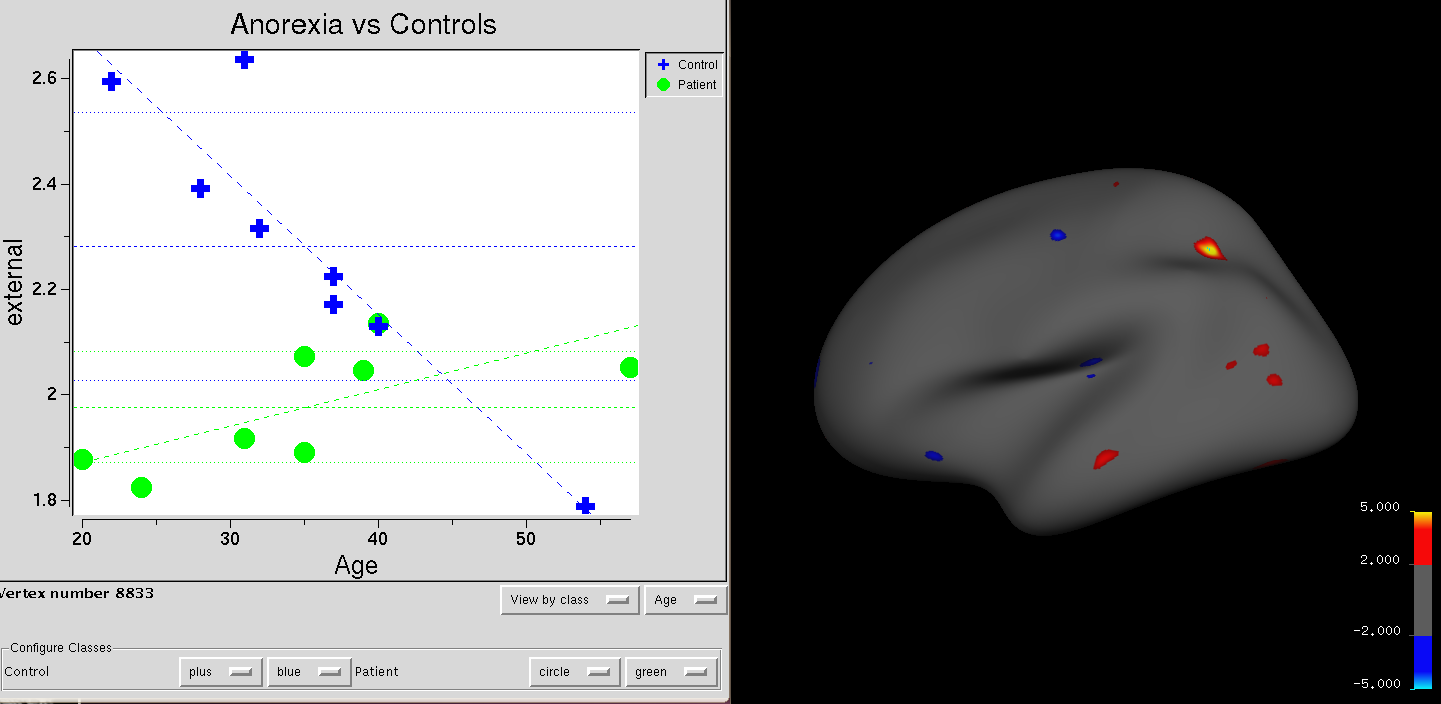
I'm not sure if this qualifies as an outlier, but I do have one individual (and the age-matched control) who is much older than the rest (see attached). Do you think elimination of this subject could make the comparison possible?
Thanks, Allie
On Tue, Mar 6, 2012 at 5:10 PM, Bruce Fischl fischl@nmr.mgh.harvard.eduwrote:
do you have a big outlier in the thickness measures? I didn't see one. It seems unlikely that all your subject have a defect in that spot
On Tue, 6 Mar 2012, Douglas N Greve wrote:
It means that any comparison depends on age. Eg, if you compare them at
an age where the lines cross, you will see no effect. If you compare them at age=0 (what you were doing before), then you see a big effect. Some statisticians will say that you cannot do the comparison in the presence of an interaction. dogu
Allie Rosen wrote:
So if my findings show that each group ages differently, does that mean I can't compare them at all because I can't regress out age? Or is there some way of comparing the groups despite this difference in aging patterns?
Thanks again, Allie
On Tue, Mar 6, 2012 at 4:44 PM, Douglas N Greve <greve@nmr.mgh.harvard.edu <mailto:greve@nmr.mgh.harvard.**edugreve@nmr.mgh.harvard.edu>> wrote:
It might, don't know
Allie Rosen wrote:
Hi Doug, Yes, I think there actually may be a topologic defect in this area, although not directly where the cluster is (attached). Could this be the cause of the thickness result? If I go back and try to repair the defect, will that make the results more typical and, more importantly, correct? Thanks again, Allie On Tue, Mar 6, 2012 at 3:57 PM, Douglas N Greve <greve@nmr.mgh.harvard.edu <mailto:greve@nmr.mgh.harvard.**edu<greve@nmr.mgh.harvard.edu><mailto:greve@nmr.mgh.harvard.**edu <greve@nmr.mgh.harvard.edu> <mailto:greve@nmr.mgh.harvard.**edu <greve@nmr.mgh.harvard.edu>>>>wrote:
Hi Allie, yes, it means that each group is affected differently by age. The controls are increasing their thickness with age in this area (which seems strange, usually you expect general decreases with age). You might check the quality of the surfaces in this area. doug Allie Rosen wrote: Hi Doug, Thanks for the response. I've actually already run an interaction contrast and the same area is still significant (attached). I'm not sure how to interpret this either, unfortunately. Does it say that both groups are affected significantly differently by age? Can you tell me what it means? I'm having problems trying to do this myself. Thanks very much, Allie On Tue, Mar 6, 2012 at 3:47 PM, Douglas N Greve <greve@nmr.mgh.harvard.edu <mailto:greve@nmr.mgh.harvard.**edu <greve@nmr.mgh.harvard.edu>> <mailto:greve@nmr.mgh.harvard.**edu <greve@nmr.mgh.harvard.edu> <mailto:greve@nmr.mgh.harvard.**edu <greve@nmr.mgh.harvard.edu>>> <mailto:greve@nmr.mgh.harvard.**edu<greve@nmr.mgh.harvard.edu> <mailto:greve@nmr.mgh.harvard.**edu <greve@nmr.mgh.harvard.edu>> <mailto:greve@nmr.mgh.harvard.**edu<greve@nmr.mgh.harvard.edu> <mailto:greve@nmr.mgh.harvard.**edu <greve@nmr.mgh.harvard.edu>>>>>wrote:
Allie, to be more precise, you have selected control<patient regressing out the effects of age. This second part is the key. If you were to trace the regression lines back to age=0 (the meaning of "regressing out age"), then control<patient by a wide margin. But you have a problem here in that the regression lines are crossed. This means that you have an interaction between age and patient (no interaction means that the lines would be parallel). An interaction means that you cannot assess whether there is a difference in the thickness because this difference changes depending upon the age. One thing you can try is to actually compute an interaction contrast (something like [0 0 1 -1]). If it is significant in this area, then there's not much you can do (though it may be interesting in itself). If it is not significant, then you can switch to a DOSS model which forces the lines to be parallel and makes the distance between the lines be independent of age. Does this make sense? doug Allie Rosen wrote: Hi All, I'm having trouble reconciling the cluster colours with the graph that can be made when you load the group descriptor file and click on a point. I've attached an example. In this study, I'm comparing thickness in a patient and control group, with age regressed out. The contrast I've used means that blue means control<patient. Therefore, patients are thicker than controls. But in the graph, patients don't seem to be thicker. I've seen the same results with red clusters (i.e. they should mean that controls are thicker but the graph shows otherwhise). Please let me know how I can interpret my findings given the graph. Which group is actually thicker? Thank you, Allison ------------------------------**------------------------------**
------------------------------**------------------------------**
______________________________**_________________ Freesurfer mailing list Freesurfer@nmr.mgh.harvard.edu <mailto:Freesurfer@nmr.mgh.**harvard.edu<Freesurfer@nmr.mgh.harvard.edu><mailto:Freesurfer@nmr.mgh.**harvard.edu<Freesurfer@nmr.mgh.harvard.edu> <mailto:Freesurfer@nmr.mgh.**harvard.edu<Freesurfer@nmr.mgh.harvard.edu><mailto:Freesurfer@nmr.mgh.**harvard.edu<Freesurfer@nmr.mgh.harvard.edu> <mailto:Freesurfer@nmr.mgh.**harvard.edu<Freesurfer@nmr.mgh.harvard.edu><mailto:Freesurfer@nmr.mgh.**harvard.edu<Freesurfer@nmr.mgh.harvard.edu> <mailto:Freesurfer@nmr.mgh.**harvard.edu<Freesurfer@nmr.mgh.harvard.edu>https://mail.nmr.mgh.harvard.**edu/mailman/listinfo/**freesurfer<https://mail.nmr.mgh.harvard.edu/mailman/listinfo/freesurfer> -- Douglas N. Greve, Ph.D. MGH-NMR Center greve@nmr.mgh.harvard.edu <mailto:greve@nmr.mgh.harvard.**edu <greve@nmr.mgh.harvard.edu>> <mailto:greve@nmr.mgh.harvard.**edu<greve@nmr.mgh.harvard.edu> <mailto:greve@nmr.mgh.harvard.**edu <greve@nmr.mgh.harvard.edu>>> <mailto:greve@nmr.mgh.harvard.**edu<greve@nmr.mgh.harvard.edu> <mailto:greve@nmr.mgh.harvard.**edu <greve@nmr.mgh.harvard.edu>> <mailto:greve@nmr.mgh.harvard.**edu<greve@nmr.mgh.harvard.edu> <mailto:greve@nmr.mgh.harvard.**edu <greve@nmr.mgh.harvard.edu>Phone Number: 617-724-2358 <tel:617-724-2358> <tel:617-724-2358 <tel:617-724-2358>> <tel:617-724-2358 <tel:617-724-2358> <tel:617-724-2358 <tel:617-724-2358>>> Fax: 617-726-7422 <tel:617-726-7422> <tel:617-726-7422 <tel:617-726-7422>> <tel:617-726-7422 <tel:617-726-7422> <tel:617-726-7422 <tel:617-726-7422>>> Bugs: surfer.nmr.mgh.harvard.edu/**fswiki/BugReporting<http://surfer.nmr.mgh.harvard.edu/fswiki/BugReporting> <http://surfer.nmr.mgh.**harvard.edu/fswiki/**BugReporting<http://surfer.nmr.mgh.harvard.edu/fswiki/BugReporting><http://surfer.nmr.mgh.**harvard.edu/fswiki/**BugReporting<http://surfer.nmr.mgh.harvard.edu/fswiki/BugReporting><http://surfer.nmr.mgh.**harvard.edu/fswiki/**BugReporting http://surfer.nmr.mgh.harvard.edu/fswiki/BugReporting> FileDrop: www.nmr.mgh.harvard.edu/**facility/filedrop/index.htmlhttp://www.nmr.mgh.harvard.edu/facility/filedrop/index.html <http://www.nmr.mgh.harvard.**edu/facility/filedrop/index.**htmlhttp://www.nmr.mgh.harvard.edu/facility/filedrop/index.html
<http://www.nmr.mgh.harvard.**edu/facility/filedrop/index.**html<http://www.nmr.mgh.harvard.edu/facility/filedrop/index.html><http://www.nmr.mgh.harvard.**edu/facility/filedrop/index.**html<http://www.nmr.mgh.harvard.edu/facility/filedrop/index.html>The information in this e-mail is intended only for the person to whom it is addressed. If you believe this e-mail was sent to you in error and the e-mail contains patient information, please contact the Partners Compliance HelpLine at http://www.partners.org/**complianceline<http://www.partners.org/complianceline>. If the e-mail was sent to you in error but does not contain patient information, please contact the sender and properly dispose of the e-mail. ------------------------------**------------------------------**
-- Douglas N. Greve, Ph.D. MGH-NMR Center greve@nmr.mgh.harvard.edu <mailto:greve@nmr.mgh.harvard.**edu <greve@nmr.mgh.harvard.edu>> <mailto:greve@nmr.mgh.harvard.**edu <greve@nmr.mgh.harvard.edu> <mailto:greve@nmr.mgh.harvard.**edu <greve@nmr.mgh.harvard.edu>>> Phone Number: 617-724-2358 <tel:617-724-2358> <tel:617-724-2358 <tel:617-724-2358>> Fax: 617-726-7422 <tel:617-726-7422> <tel:617-726-7422 <tel:617-726-7422>> Bugs: surfer.nmr.mgh.harvard.edu/**fswiki/BugReporting<http://surfer.nmr.mgh.harvard.edu/fswiki/BugReporting> <http://surfer.nmr.mgh.**harvard.edu/fswiki/**BugReporting<http://surfer.nmr.mgh.harvard.edu/fswiki/BugReporting><http://surfer.nmr.mgh.**harvard.edu/fswiki/**BugReporting<http://surfer.nmr.mgh.harvard.edu/fswiki/BugReporting>FileDrop: www.nmr.mgh.harvard.edu/**facility/filedrop/index.html<http://www.nmr.mgh.harvard.edu/facility/filedrop/index.html> <http://www.nmr.mgh.harvard.**edu/facility/filedrop/index.**html<http://www.nmr.mgh.harvard.edu/facility/filedrop/index.html><http://www.nmr.mgh.harvard.**edu/facility/filedrop/index.**html http://www.nmr.mgh.harvard.edu/facility/filedrop/index.html>
------------------------------**------------------------------**
-- Douglas N. Greve, Ph.D. MGH-NMR Center greve@nmr.mgh.harvard.edu <mailto:greve@nmr.mgh.harvard.**edugreve@nmr.mgh.harvard.edu
Phone Number: 617-724-2358 tel:617-724-2358 Fax: 617-726-7422 tel:617-726-7422
Bugs: surfer.nmr.mgh.harvard.edu/**fswiki/BugReportinghttp://surfer.nmr.mgh.harvard.edu/fswiki/BugReporting <http://surfer.nmr.mgh.**harvard.edu/fswiki/**BugReportinghttp://surfer.nmr.mgh.harvard.edu/fswiki/BugReporting
FileDrop: www.nmr.mgh.harvard.edu/**facility/filedrop/index.htmlhttp://www.nmr.mgh.harvard.edu/facility/filedrop/index.html <http://www.nmr.mgh.harvard.**edu/facility/filedrop/index.**htmlhttp://www.nmr.mgh.harvard.edu/facility/filedrop/index.html
Hi Allie
the real question is whether the surfaces are accurate in that place for that subject. The only way to tell is to visually inspect them.
cheers Bruce On Wed, 7 Mar 2012, Allie Rosen wrote:
Hi Bruce, I'm not sure if this qualifies as an outlier, but I do have one individual (and the age-matched control) who is much older than the rest (see attached). Do you think elimination of this subject could make the comparison possible?
Thanks, Allie
On Tue, Mar 6, 2012 at 5:10 PM, Bruce Fischl fischl@nmr.mgh.harvard.edu wrote: do you have a big outlier in the thickness measures? I didn't see one. It seems unlikely that all your subject have a defect in that spot On Tue, 6 Mar 2012, Douglas N Greve wrote:
It means that any comparison depends on age. Eg, if you compare them at an age where the lines cross, you will see no effect. If you compare them at age=0 (what you were doing before), then you see a big effect. Some statisticians will say that you cannot do the comparison in the presence of an interaction. dogu Allie Rosen wrote: So if my findings show that each group ages differently, does that mean I can't compare them at all because I can't regress out age? Or is there some way of comparing the groups despite this difference in aging patterns? Thanks again, Allie On Tue, Mar 6, 2012 at 4:44 PM, Douglas N Greve <greve@nmr.mgh.harvard.edu <mailto:greve@nmr.mgh.harvard.edu>> wrote: It might, don't know Allie Rosen wrote: Hi Doug, Yes, I think there actually may be a topologic defect in this area, although not directly where the cluster is (attached). Could this be the cause of the thickness result? If I go back and try to repair the defect, will that make the results more typical and, more importantly, correct? Thanks again, Allie On Tue, Mar 6, 2012 at 3:57 PM, Douglas N Greve <greve@nmr.mgh.harvard.edu <mailto:greve@nmr.mgh.harvard.edu> <mailto:greve@nmr.mgh.harvard.edu <mailto:greve@nmr.mgh.harvard.edu>>> wrote: Hi Allie, yes, it means that each group is affected differently by age. The controls are increasing their thickness with age in this area (which seems strange, usually you expect general decreases with age). You might check the quality of the surfaces in this area. doug Allie Rosen wrote: Hi Doug, Thanks for the response. I've actually already run an interaction contrast and the same area is still significant (attached). I'm not sure how to interpret this either, unfortunately. Does it say that both groups are affected significantly differently by age? Can you tell me what it means? I'm having problems trying to do this myself. Thanks very much, Allie On Tue, Mar 6, 2012 at 3:47 PM, Douglas N Greve <greve@nmr.mgh.harvard.edu <mailto:greve@nmr.mgh.harvard.edu> <mailto:greve@nmr.mgh.harvard.edu <mailto:greve@nmr.mgh.harvard.edu>> <mailto:greve@nmr.mgh.harvard.edu <mailto:greve@nmr.mgh.harvard.edu> <mailto:greve@nmr.mgh.harvard.edu <mailto:greve@nmr.mgh.harvard.edu>>>> wrote: Allie, to be more precise, you have selected control<patient regressing out the effects of age. This second part is the key. If you were to trace the regression lines back to age=0 (the meaning of "regressing out age"), then control<patient by a wide margin. But you have a problem here in that the regression lines are crossed. This means that you have an interaction between age and patient (no interaction means that the lines would be parallel). An interaction means that you cannot assess whether there is a difference in the thickness because this difference changes depending upon the age. One thing you can try is to actually compute an interaction contrast (something like [0 0 1 -1]). If it is significant in this area, then there's not much you can do (though it may be interesting in itself). If it is not significant, then you can switch to a DOSS model which forces the lines to be parallel and makes the distance between the lines be independent of age. Does this make sense? doug Allie Rosen wrote: Hi All, I'm having trouble reconciling the cluster colours with the graph that can be made when you load the group descriptor file and click on a point. I've attached an example. In this study, I'm comparing thickness in a patient and control group, with age regressed out. The contrast I've used means that blue means control<patient. Therefore, patients are thicker than controls. But in the graph, patients don't seem to be thicker. I've seen the same results with red clusters (i.e. they should mean that controls are thicker but the graph shows otherwhise). Please let me know how I can interpret my findings given the graph. Which group is actually thicker? Thank you, Allison ------------------------------------------------------------------------ ------------------------------------------------------------------------ _______________________________________________ Freesurfer mailing list Freesurfer@nmr.mgh.harvard.edu <mailto:Freesurfer@nmr.mgh.harvard.edu> <mailto:Freesurfer@nmr.mgh.harvard.edu <mailto:Freesurfer@nmr.mgh.harvard.edu>> <mailto:Freesurfer@nmr.mgh.harvard.edu <mailto:Freesurfer@nmr.mgh.harvard.edu> <mailto:Freesurfer@nmr.mgh.harvard.edu <mailto:Freesurfer@nmr.mgh.harvard.edu>>> https://mail.nmr.mgh.harvard.edu/mailman/listinfo/freesurfer -- Douglas N. Greve, Ph.D. MGH-NMR Center greve@nmr.mgh.harvard.edu <mailto:greve@nmr.mgh.harvard.edu> <mailto:greve@nmr.mgh.harvard.edu <mailto:greve@nmr.mgh.harvard.edu>> <mailto:greve@nmr.mgh.harvard.edu <mailto:greve@nmr.mgh.harvard.edu> <mailto:greve@nmr.mgh.harvard.edu <mailto:greve@nmr.mgh.harvard.edu>>> Phone Number: 617-724-2358 <tel:617-724-2358> <tel:617-724-2358 <tel:617-724-2358>> <tel:617-724-2358 <tel:617-724-2358> <tel:617-724-2358 <tel:617-724-2358>>> Fax: 617-726-7422 <tel:617-726-7422> <tel:617-726-7422 <tel:617-726-7422>> <tel:617-726-7422 <tel:617-726-7422> <tel:617-726-7422 <tel:617-726-7422>>> Bugs: surfer.nmr.mgh.harvard.edu/fswiki/BugReporting <http://surfer.nmr.mgh.harvard.edu/fswiki/BugReporting> <http://surfer.nmr.mgh.harvard.edu/fswiki/BugReporting> <http://surfer.nmr.mgh.harvard.edu/fswiki/BugReporting> FileDrop: www.nmr.mgh.harvard.edu/facility/filedrop/index.html <http://www.nmr.mgh.harvard.edu/facility/filedrop/index.html> <http://www.nmr.mgh.harvard.edu/facility/filedrop/index.html> <http://www.nmr.mgh.harvard.edu/facility/filedrop/index.html> The information in this e-mail is intended only for the person to whom it is addressed. If you believe this e-mail was sent to you in error and the e-mail contains patient information, please contact the Partners Compliance HelpLine at http://www.partners.org/complianceline . If the e-mail was sent to you in error but does not contain patient information, please contact the sender and properly dispose of the e-mail. ------------------------------------------------------------------------ -- Douglas N. Greve, Ph.D. MGH-NMR Center greve@nmr.mgh.harvard.edu <mailto:greve@nmr.mgh.harvard.edu> <mailto:greve@nmr.mgh.harvard.edu <mailto:greve@nmr.mgh.harvard.edu>> Phone Number: 617-724-2358 <tel:617-724-2358> <tel:617-724-2358 <tel:617-724-2358>> Fax: 617-726-7422 <tel:617-726-7422> <tel:617-726-7422 <tel:617-726-7422>> Bugs: surfer.nmr.mgh.harvard.edu/fswiki/BugReporting <http://surfer.nmr.mgh.harvard.edu/fswiki/BugReporting> <http://surfer.nmr.mgh.harvard.edu/fswiki/BugReporting> FileDrop: www.nmr.mgh.harvard.edu/facility/filedrop/index.html <http://www.nmr.mgh.harvard.edu/facility/filedrop/index.html> <http://www.nmr.mgh.harvard.edu/facility/filedrop/index.html> ------------------------------------------------------------------------ -- Douglas N. Greve, Ph.D. MGH-NMR Center greve@nmr.mgh.harvard.edu <mailto:greve@nmr.mgh.harvard.edu> Phone Number: 617-724-2358 <tel:617-724-2358> Fax: 617-726-7422 <tel:617-726-7422> Bugs: surfer.nmr.mgh.harvard.edu/fswiki/BugReporting <http://surfer.nmr.mgh.harvard.edu/fswiki/BugReporting> FileDrop: www.nmr.mgh.harvard.edu/facility/filedrop/index.html <http://www.nmr.mgh.harvard.edu/facility/filedrop/index.html>
Hi Bruce and Doug,
Given the fact that all my surfaces for my 16 patients and controls are fine, I'm still left with some basic questions:
Since there is this interaction effect for age, how can I actually compare the thickness of the two populations?
And should I be worried about the fact that some areas are thickening with age, despite the fact that this isn't caused by defects in the surface topology of the subjects?
Thank you for the help, Allie
On Wed, Mar 7, 2012 at 10:02 AM, Bruce Fischl fischl@nmr.mgh.harvard.eduwrote:
Hi Allie
the real question is whether the surfaces are accurate in that place for that subject. The only way to tell is to visually inspect them.
cheers Bruce
On Wed, 7 Mar 2012, Allie Rosen wrote:
Hi Bruce,
I'm not sure if this qualifies as an outlier, but I do have one individual (and the age-matched control) who is much older than the rest (see attached). Do you think elimination of this subject could make the comparison possible?
Thanks, Allie
On Tue, Mar 6, 2012 at 5:10 PM, Bruce Fischl fischl@nmr.mgh.harvard.edu wrote: do you have a big outlier in the thickness measures? I didn't see one. It seems unlikely that all your subject have a defect in that spot On Tue, 6 Mar 2012, Douglas N Greve wrote:
It means that any comparison depends on age. Eg, if youcompare them at an age where the lines cross, you will see no effect. If you compare them at age=0 (what you were doing before), then you see a big effect. Some statisticians will say that you cannot do the comparison in the presence of an interaction. dogu
Allie Rosen wrote: So if my findings show that each group ages differently,does that mean I can't compare them at all because I can't regress out age? Or is there some way of comparing the groups despite this difference in aging patterns?
Thanks again, Allie On Tue, Mar 6, 2012 at 4:44 PM, Douglas N Greve <greve@nmr.mgh.harvard.edu <mailto:greve@nmr.mgh.harvard.**edu greve@nmr.mgh.harvard.edu>> wrote:
It might, don't know Allie Rosen wrote: Hi Doug, Yes, I think there actually may be a topologicdefect in this area, although not directly where the cluster is (attached). Could this be the cause of the thickness result? If I go back and try to repair the defect, will that make the results more typical and, more importantly, correct?
Thanks again, Allie On Tue, Mar 6, 2012 at 3:57 PM, Douglas N Greve <greve@nmr.mgh.harvard.edu <mailto:greve@nmr.mgh.harvard.**edu greve@nmr.mgh.harvard.edu> <mailto:greve@nmr.mgh.**harvard.edugreve@nmr.mgh.harvard.edu <mailto:greve@nmr.mgh.**harvard.edugreve@nmr.mgh.harvard.edu>>> wrote:
Hi Allie, yes, it means that each group isaffected differently by age. The controls are increasing their thickness with age in this area (which seems strange, usually you expect general decreases with age). You might check the quality of the surfaces in this area. doug
Allie Rosen wrote: Hi Doug, Thanks for the response. I've actuallyalready run an interaction contrast and the same area is still significant (attached). I'm not sure how to interpret this either, unfortunately. Does it say that both groups are affected significantly differently by age? Can you tell me what it means? I'm having problems trying to do this myself.
Thanks very much, Allie On Tue, Mar 6, 2012 at 3:47 PM, Douglas NGreve <greve@nmr.mgh.harvard.edu <mailto:greve@nmr.mgh.**harvard.edugreve@nmr.mgh.harvard.edu
<mailto:greve@nmr.mgh.**harvard.edu<greve@nmr.mgh.harvard.edu> <mailto:greve@nmr.mgh.**harvard.edu<greve@nmr.mgh.harvard.edu><mailto:greve@nmr.mgh.harvard.**edu<greve@nmr.mgh.harvard.edu> <mailto:greve@nmr.mgh.**harvard.edu<greve@nmr.mgh.harvard.edu><mailto:greve@nmr.mgh.harvard.**edu<greve@nmr.mgh.harvard.edu> <mailto:greve@nmr.mgh.**harvard.edu<greve@nmr.mgh.harvard.edu>>>>>wrote:
Allie, to be more precise, you haveselected control<patient regressing out the effects of age. This second part is the key. If you were to trace the regression lines back to age=0 (the meaning of "regressing out age"), then control<patient by a wide margin. But you have a problem here in that the regression lines are crossed. This means that you have an interaction between age and patient (no interaction means that the lines would be parallel). An interaction means that you cannot assess whether there is a difference in the thickness because this difference changes depending upon the age. One thing you can try is to actually compute an interaction contrast (something like [0 0 1 -1]). If it is significant in this area, then there's not much you can do (though it may be interesting in itself). If it is not significant, then you can switch to a DOSS model which forces the lines to be parallel and makes the distance between the lines be independent of age. Does this make sense? doug
Allie Rosen wrote: Hi All, I'm having trouble reconciling thecluster colours with the graph that can be made when you load the group descriptor file and click on a point. I've attached an example. In this study, I'm comparing thickness in a patient and control group, with age regressed out. The contrast I've used means that blue means control<patient. Therefore, patients are thicker than controls. But in the graph, patients don't seem to be thicker. I've seen the same results with red clusters (i.e. they should mean that controls are thicker but the graph shows otherwhise). Please let me know how I can interpret my findings given the graph. Which group is actually thicker?
Thank you, Allison ------------------------------**------------------------------**------------
------------------------------**------------------------------**------------
_____________________________**
Freesurfer mailing list Freesurfer@nmr.mgh.harvard.**edu<Freesurfer@nmr.mgh.harvard.edu> <mailto:Freesurfer@nmr.mgh.**harvard.edu<Freesurfer@nmr.mgh.harvard.edu><mailto:Freesurfer@nmr.mgh.**harvard.edu<Freesurfer@nmr.mgh.harvard.edu> <mailto:Freesurfer@nmr.mgh.**harvard.edu<Freesurfer@nmr.mgh.harvard.edu><mailto:Freesurfer@nmr.mgh.**harvard.edu Freesurfer@nmr.mgh.harvard.edu <mailto:Freesurfer@nmr.mgh.**harvard.eduFreesurfer@nmr.mgh.harvard.edu
<mailto:Freesurfer@nmr.mgh.**harvard.edu<Freesurfer@nmr.mgh.harvard.edu> <mailto:Freesurfer@nmr.mgh.**harvard.edu<Freesurfer@nmr.mgh.harvard.edu>https://mail.nmr.mgh.harvard.**edu/mailman/listinfo/**freesurferhttps://mail.nmr.mgh.harvard.edu/mailman/listinfo/freesurfer
-- Douglas N. Greve, Ph.D. MGH-NMR Center greve@nmr.mgh.harvard.edu <mailto:greve@nmr.mgh.**harvard.edu<greve@nmr.mgh.harvard.edu><mailto:greve@nmr.mgh.harvard.**edu<greve@nmr.mgh.harvard.edu> <mailto:greve@nmr.mgh.**harvard.edu<greve@nmr.mgh.harvard.edu><mailto:greve@nmr.mgh.harvard.**edu<greve@nmr.mgh.harvard.edu> <mailto:greve@nmr.mgh.**harvard.edu<greve@nmr.mgh.harvard.edu><mailto:greve@nmr.mgh.harvard.**edu<greve@nmr.mgh.harvard.edu> <mailto:greve@nmr.mgh.**harvard.edu<greve@nmr.mgh.harvard.edu>Phone Number: 617-724-2358 <tel:617-724-2358> <tel:617-724-2358 tel:617-724-2358> <tel:617-724-2358 tel:617-724-2358 <tel: 617-724-2358 tel:617-724-2358>> Fax: 617-726-7422 tel: 617-726-7422 <tel:617-726-7422 tel:617-726-7422> <tel:617-726-7422 tel:617-726-7422 <tel:617-726-7422 tel:617-726-7422>>
Bugs: surfer.nmr.mgh.harvard.edu/**fswiki/BugReportinghttp://surfer.nmr.mgh.harvard.edu/fswiki/BugReporting <http://surfer.nmr.mgh.**harvard.edu/fswiki/** BugReporting http://surfer.nmr.mgh.harvard.edu/fswiki/BugReporting> <http://surfer.nmr.mgh.** harvard.edu/fswiki/**BugReportinghttp://surfer.nmr.mgh.harvard.edu/fswiki/BugReporting
<http://surfer.nmr.mgh.**harvard.edu/fswiki/**BugReportinghttp://surfer.nmr.mgh.harvard.edu/fswiki/BugReporting
FileDrop: www.nmr.mgh.harvard.edu/**facility/filedrop/index.htmlhttp://www.nmr.mgh.harvard.edu/facility/filedrop/index.html <http://www.nmr.mgh.harvard.** edu/facility/filedrop/index.**htmlhttp://www.nmr.mgh.harvard.edu/facility/filedrop/index.html
<http://www.nmr.mgh.harvard.**edu/facility/filedrop/index.**htmlhttp://www.nmr.mgh.harvard.edu/facility/filedrop/index.html
<http://www.nmr.mgh.harvard.**edu/facility/filedrop/index.**htmlhttp://www.nmr.mgh.harvard.edu/facility/filedrop/index.html
The information in this e-mail isintended only for the person to whom it is addressed. If you believe this e-mail was sent to you in error and the e-mail contains patient information, please contact the Partners Compliance HelpLine at http://www.partners.org/** complianceline http://www.partners.org/complianceline . If the e-mail was sent to you in error but does not contain patient information, please contact the sender and properly dispose of the e-mail.
------------------------------**------------------------------**------------
-- Douglas N. Greve, Ph.D. MGH-NMR Center greve@nmr.mgh.harvard.edu <mailto:greve@nmr.mgh.**harvard.edu<greve@nmr.mgh.harvard.edu><mailto:greve@nmr.mgh.**harvard.edu<greve@nmr.mgh.harvard.edu> <mailto:greve@nmr.mgh.**harvard.edu<greve@nmr.mgh.harvard.edu>Phone Number: 617-724-2358 <tel:617-724-2358> <tel:617-724-2358 <tel:617-724-2358>> Fax:617-726-7422 tel:617-726-7422 <tel:617-726-7422 tel:617-726-7422>
Bugs: surfer.nmr.mgh.harvard.edu/**fswiki/BugReportinghttp://surfer.nmr.mgh.harvard.edu/fswiki/BugReporting <http://surfer.nmr.mgh.**harvard.edu/fswiki/** BugReporting http://surfer.nmr.mgh.harvard.edu/fswiki/BugReporting> <http://surfer.nmr.mgh.**harvard.edu/fswiki/** BugReporting http://surfer.nmr.mgh.harvard.edu/fswiki/BugReporting> FileDrop: www.nmr.mgh.harvard.edu/** facility/filedrop/index.htmlhttp://www.nmr.mgh.harvard.edu/facility/filedrop/index.html <http://www.nmr.mgh.harvard.** edu/facility/filedrop/index.**htmlhttp://www.nmr.mgh.harvard.edu/facility/filedrop/index.html
<http://www.nmr.mgh.harvard.**edu/facility/filedrop/index.**htmlhttp://www.nmr.mgh.harvard.edu/facility/filedrop/index.html
-----------------------------**------------------------------**-------------
-- Douglas N. Greve, Ph.D. MGH-NMR Center greve@nmr.mgh.harvard.edu <mailto:greve@nmr.mgh.harvard.**edu greve@nmr.mgh.harvard.edu> Phone Number: 617-724-2358 tel:617-724-2358 Fax: 617-726-7422 tel:617-726-7422
Bugs: surfer.nmr.mgh.harvard.edu/**fswiki/BugReportinghttp://surfer.nmr.mgh.harvard.edu/fswiki/BugReporting <http://surfer.nmr.mgh.**harvard.edu/fswiki/** BugReporting http://surfer.nmr.mgh.harvard.edu/fswiki/BugReporting> FileDrop: www.nmr.mgh.harvard.edu/** facility/filedrop/index.htmlhttp://www.nmr.mgh.harvard.edu/facility/filedrop/index.html <http://www.nmr.mgh.harvard.** edu/facility/filedrop/index.**htmlhttp://www.nmr.mgh.harvard.edu/facility/filedrop/index.html
Hi Allie
perhaps David Salat (ccd) can comment. He definitely saw some areas that thickened with age. They weren't common, but they were definitely in the data.
cheers Bruce
On Wed, 7 Mar 2012, Allie Rosen wrote:
Hi Bruce and Doug, Given the fact that all my surfaces for my 16 patients and controls are fine, I'm still left with some basic questions:
Since there is this interaction effect for age, how can I actually compare the thickness of the two populations?
And should I be worried about the fact that some areas are thickening with age, despite the fact that this isn't caused by defects in the surface topology of the subjects?
Thank you for the help, Allie
On Wed, Mar 7, 2012 at 10:02 AM, Bruce Fischl fischl@nmr.mgh.harvard.edu wrote: Hi Allie
the real question is whether the surfaces are accurate in that place for that subject. The only way to tell is to visually inspect them. cheers Bruce On Wed, 7 Mar 2012, Allie Rosen wrote: Hi Bruce, I'm not sure if this qualifies as an outlier, but I do have one individual (and the age-matched control) who is much older than the rest (see attached). Do you think elimination of this subject could make the comparison possible? Thanks, Allie On Tue, Mar 6, 2012 at 5:10 PM, Bruce Fischl <fischl@nmr.mgh.harvard.edu> wrote: do you have a big outlier in the thickness measures? I didn't see one. It seems unlikely that all your subject have a defect in that spot On Tue, 6 Mar 2012, Douglas N Greve wrote: It means that any comparison depends on age. Eg, if you compare them at an age where the lines cross, you will see no effect. If you compare them at age=0 (what you were doing before), then you see a big effect. Some statisticians will say that you cannot do the comparison in the presence of an interaction. dogu Allie Rosen wrote: So if my findings show that each group ages differently, does that mean I can't compare them at all because I can't regress out age? Or is there some way of comparing the groups despite this difference in aging patterns? Thanks again, Allie On Tue, Mar 6, 2012 at 4:44 PM, Douglas N Greve <greve@nmr.mgh.harvard.edu <mailto:greve@nmr.mgh.harvard.edu>> wrote: It might, don't know Allie Rosen wrote: Hi Doug, Yes, I think there actually may be a topologic defect in this area, although not directly where the cluster is (attached). Could this be the cause of the thickness result? If I go back and try to repair the defect, will that make the results more typical and, more importantly, correct? Thanks again, Allie On Tue, Mar 6, 2012 at 3:57 PM, Douglas N Greve <greve@nmr.mgh.harvard.edu <mailto:greve@nmr.mgh.harvard.edu> <mailto:greve@nmr.mgh.harvard.edu <mailto:greve@nmr.mgh.harvard.edu>>> wrote: Hi Allie, yes, it means that each group is affected differently by age. The controls are increasing their thickness with age in this area (which seems strange, usually you expect general decreases with age). You might check the quality of the surfaces in this area. doug Allie Rosen wrote: Hi Doug, Thanks for the response. I've actually already run an interaction contrast and the same area is still significant (attached). I'm not sure how to interpret this either, unfortunately. Does it say that both groups are affected significantly differently by age? Can you tell me what it means? I'm having problems trying to do this myself. Thanks very much, Allie On Tue, Mar 6, 2012 at 3:47 PM, Douglas N Greve <greve@nmr.mgh.harvard.edu <mailto:greve@nmr.mgh.harvard.edu> <mailto:greve@nmr.mgh.harvard.edu <mailto:greve@nmr.mgh.harvard.edu>> <mailto:greve@nmr.mgh.harvard.edu <mailto:greve@nmr.mgh.harvard.edu> <mailto:greve@nmr.mgh.harvard.edu <mailto:greve@nmr.mgh.harvard.edu>>>> wrote: Allie, to be more precise, you have selected control<patient regressing out the effects of age. This second part is the key. If you were to trace the regression lines back to age=0 (the meaning of "regressing out age"), then control<patient by a wide margin. But you have a problem here in that the regression lines are crossed. This means that you have an interaction between age and patient (no interaction means that the lines would be parallel). An interaction means that you cannot assess whether there is a difference in the thickness because this difference changes depending upon the age. One thing you can try is to actually compute an interaction contrast (something like [0 0 1 -1]). If it is significant in this area, then there's not much you can do (though it may be interesting in itself). If it is not significant, then you can switch to a DOSS model which forces the lines to be parallel and makes the distance between the lines be independent of age. Does this make sense? doug Allie Rosen wrote: Hi All, I'm having trouble reconciling the cluster colours with the graph that can be made when you load the group descriptor file and click on a point. I've attached an example. In this study, I'm comparing thickness in a patient and control group, with age regressed out. The contrast I've used means that blue means control<patient. Therefore, patients are thicker than controls. But in the graph, patients don't seem to be thicker. I've seen the same results with red clusters (i.e. they should mean that controls are thicker but the graph shows otherwhise). Please let me know how I can interpret my findings given the graph. Which group is actually thicker? Thank you, Allison ------------------------------------------------------------------------ ------------------------------------------------------------------------ _______________________________________________ Freesurfer mailing list Freesurfer@nmr.mgh.harvard.edu <mailto:Freesurfer@nmr.mgh.harvard.edu> <mailto:Freesurfer@nmr.mgh.harvard.edu <mailto:Freesurfer@nmr.mgh.harvard.edu>> <mailto:Freesurfer@nmr.mgh.harvard.edu <mailto:Freesurfer@nmr.mgh.harvard.edu> <mailto:Freesurfer@nmr.mgh.harvard.edu <mailto:Freesurfer@nmr.mgh.harvard.edu>>> https://mail.nmr.mgh.harvard.edu/mailman/listinfo/freesurfer -- Douglas N. Greve, Ph.D. MGH-NMR Center greve@nmr.mgh.harvard.edu <mailto:greve@nmr.mgh.harvard.edu> <mailto:greve@nmr.mgh.harvard.edu <mailto:greve@nmr.mgh.harvard.edu>> <mailto:greve@nmr.mgh.harvard.edu <mailto:greve@nmr.mgh.harvard.edu> <mailto:greve@nmr.mgh.harvard.edu <mailto:greve@nmr.mgh.harvard.edu>>> Phone Number: 617-724-2358 <tel:617-724-2358> <tel:617-724-2358 <tel:617-724-2358>> <tel:617-724-2358 <tel:617-724-2358> <tel:617-724-2358 <tel:617-724-2358>>> Fax: 617-726-7422 <tel:617-726-7422> <tel:617-726-7422 <tel:617-726-7422>> <tel:617-726-7422 <tel:617-726-7422> <tel:617-726-7422 <tel:617-726-7422>>> Bugs: surfer.nmr.mgh.harvard.edu/fswiki/BugReporting <http://surfer.nmr.mgh.harvard.edu/fswiki/BugReporting> <http://surfer.nmr.mgh.harvard.edu/fswiki/BugReporting> <http://surfer.nmr.mgh.harvard.edu/fswiki/BugReporting> FileDrop: www.nmr.mgh.harvard.edu/facility/filedrop/index.html <http://www.nmr.mgh.harvard.edu/facility/filedrop/index.html> <http://www.nmr.mgh.harvard.edu/facility/filedrop/index.html> <http://www.nmr.mgh.harvard.edu/facility/filedrop/index.html> The information in this e-mail is intended only for the person to whom it is addressed. If you believe this e-mail was sent to you in error and the e-mail contains patient information, please contact the Partners Compliance HelpLine at http://www.partners.org/complianceline . If the e-mail was sent to you in error but does not contain patient information, please contact the sender and properly dispose of the e-mail. ------------------------------------------------------------------------ -- Douglas N. Greve, Ph.D. MGH-NMR Center greve@nmr.mgh.harvard.edu <mailto:greve@nmr.mgh.harvard.edu> <mailto:greve@nmr.mgh.harvard.edu <mailto:greve@nmr.mgh.harvard.edu>> Phone Number: 617-724-2358 <tel:617-724-2358> <tel:617-724-2358 <tel:617-724-2358>> Fax: 617-726-7422 <tel:617-726-7422> <tel:617-726-7422 <tel:617-726-7422>> Bugs: surfer.nmr.mgh.harvard.edu/fswiki/BugReporting <http://surfer.nmr.mgh.harvard.edu/fswiki/BugReporting> <http://surfer.nmr.mgh.harvard.edu/fswiki/BugReporting> FileDrop: www.nmr.mgh.harvard.edu/facility/filedrop/index.html <http://www.nmr.mgh.harvard.edu/facility/filedrop/index.html> <http://www.nmr.mgh.harvard.edu/facility/filedrop/index.html> ------------------------------------------------------------------------ -- Douglas N. Greve, Ph.D. MGH-NMR Center greve@nmr.mgh.harvard.edu <mailto:greve@nmr.mgh.harvard.edu> Phone Number: 617-724-2358 <tel:617-724-2358> Fax: 617-726-7422 <tel:617-726-7422> Bugs: surfer.nmr.mgh.harvard.edu/fswiki/BugReporting <http://surfer.nmr.mgh.harvard.edu/fswiki/BugReporting> FileDrop: www.nmr.mgh.harvard.edu/facility/filedrop/index.html <http://www.nmr.mgh.harvard.edu/facility/filedrop/index.html>
Hi David,
I'm not sure how much of this conversation you can see, but I'd really appreciate your help with the issues I'm having. Please let me know if I can explain anything to you in more detail.
Thank you, Allie
On Wed, Mar 7, 2012 at 1:34 PM, Bruce Fischl fischl@nmr.mgh.harvard.eduwrote:
Hi Allie
perhaps David Salat (ccd) can comment. He definitely saw some areas that thickened with age. They weren't common, but they were definitely in the data.
cheers Bruce
On Wed, 7 Mar 2012, Allie Rosen wrote:
Hi Bruce and Doug,
Given the fact that all my surfaces for my 16 patients and controls are fine, I'm still left with some basic questions:
Since there is this interaction effect for age, how can I actually compare the thickness of the two populations?
And should I be worried about the fact that some areas are thickening with age, despite the fact that this isn't caused by defects in the surface topology of the subjects?
Thank you for the help, Allie
On Wed, Mar 7, 2012 at 10:02 AM, Bruce Fischl fischl@nmr.mgh.harvard.edu wrote: Hi Allie
the real question is whether the surfaces are accurate in that placefor that subject. The only way to tell is to visually inspect them.
cheers Bruce On Wed, 7 Mar 2012, Allie Rosen wrote: Hi Bruce, I'm not sure if this qualifies as an outlier, but I do haveone individual (and the age-matched control) who is much older than the rest (see attached). Do you think elimination of this subject could make the comparison possible?
Thanks, Allie On Tue, Mar 6, 2012 at 5:10 PM, Bruce Fischl <fischl@nmr.mgh.harvard.edu> wrote: do you have a big outlier in the thickness measures? I didn't see one. It seems unlikely that all your subject have a defect in that spot On Tue, 6 Mar 2012, Douglas N Greve wrote:
It means that any comparison depends on age. Eg, ifyou compare them at an age where the lines cross, you will see no effect. If you compare them at age=0 (what you were doing before), then you see a big effect. Some statisticians will say that you cannot do the comparison in the presence of an interaction. dogu
Allie Rosen wrote: So if my findings show that each group agesdifferently, does that mean I can't compare them at all because I can't regress out age? Or is there some way of comparing the groups despite this difference in aging patterns?
Thanks again, Allie On Tue, Mar 6, 2012 at 4:44 PM, Douglas NGreve <greve@nmr.mgh.harvard.edu <mailto: greve@nmr.mgh.harvard.**edu greve@nmr.mgh.harvard.edu>> wrote:
It might, don't know Allie Rosen wrote: Hi Doug, Yes, I think there actually may be atopologic defect in this area, although not directly where the cluster is (attached). Could this be the cause of the thickness result? If I go back and try to repair the defect, will that make the results more typical and, more importantly, correct?
Thanks again, Allie On Tue, Mar 6, 2012 at 3:57 PM,Douglas N Greve <greve@nmr.mgh.harvard.edu <mailto: greve@nmr.mgh.harvard.**edu greve@nmr.mgh.harvard.edu> <mailto:greve@nmr.mgh.**harvard.edugreve@nmr.mgh.harvard.edu <mailto:greve@nmr.mgh.**harvard.edugreve@nmr.mgh.harvard.edu>>> wrote:
Hi Allie, yes, it means that eachgroup is affected differently by age. The controls are increasing their thickness with age in this area (which seems strange, usually you expect general decreases with age). You might check the quality of the surfaces in this area. doug
Allie Rosen wrote: Hi Doug, Thanks for the response. I'veactually already run an interaction contrast and the same area is still significant (attached). I'm not sure how to interpret this either, unfortunately. Does it say that both groups are affected significantly differently by age? Can you tell me what it means? I'm having problems trying to do this myself.
Thanks very much, Allie On Tue, Mar 6, 2012 at 3:47 PM,Douglas N Greve <greve@nmr.mgh.harvard.edu <mailto:greve@nmr.mgh.**harvard.edugreve@nmr.mgh.harvard.edu
<mailto:greve@nmr.mgh.**harvard.edu<greve@nmr.mgh.harvard.edu> <mailto:greve@nmr.mgh.**harvard.edu<greve@nmr.mgh.harvard.edu><mailto:greve@nmr.mgh.harvard.**edu greve@nmr.mgh.harvard.edu <mailto:greve@nmr.mgh.**harvard.edugreve@nmr.mgh.harvard.edu
<mailto:greve@nmr.mgh.harvard.**edu greve@nmr.mgh.harvard.edu <mailto:greve@nmr.mgh.**harvard.edugreve@nmr.mgh.harvard.edu>>>> wrote:
Allie, to be more precise,you have selected control<patient regressing out the effects of age. This second part is the key. If you were to trace the regression lines back to age=0 (the meaning of "regressing out age"), then control<patient by a wide margin. But you have a problem here in that the regression lines are crossed. This means that you have an interaction between age and patient (no interaction means that the lines would be parallel). An interaction means that you cannot assess whether there is a difference in the thickness because this difference changes depending upon the age. One thing you can try is to actually compute an interaction contrast (something like [0 0 1 -1]). If it is significant in this area, then there's not much you can do (though it may be interesting in itself). If it is not significant, then you can switch to a DOSS model which forces the lines to be parallel and makes the distance between the lines be independent of age. Does this make sense? doug
Allie Rosen wrote: Hi All, I'm having troublereconciling the cluster colours with the graph that can be made when you load the group descriptor file and click on a point. I've attached an example. In this study, I'm comparing thickness in a patient and control group, with age regressed out. The contrast I've used means that blue means control<patient. Therefore, patients are thicker than controls. But in the graph, patients don't seem to be thicker. I've seen the same results with red clusters (i.e. they should mean that controls are thicker but the graph shows otherwhise). Please let me know how I can interpret my findings given the graph. Which group is actually thicker?
                                  Thank you,
                                  Allison


                     ------------------------------**
------------------------------**------------
------------------------------**------------------------------**------------
_____________________________**__________________ Freesurfer mailing list
Freesurfer@nmr.mgh.harvard.**edu Freesurfer@nmr.mgh.harvard.edu <mailto:Freesurfer@nmr.mgh.** harvard.edu Freesurfer@nmr.mgh.harvard.edu> <mailto:Freesurfer@nmr.mgh.** harvard.edu Freesurfer@nmr.mgh.harvard.edu <mailto:Freesurfer@nmr.mgh.** harvard.edu Freesurfer@nmr.mgh.harvard.edu>> <mailto: Freesurfer@nmr.mgh.**harvard.edu Freesurfer@nmr.mgh.harvard.edu <mailto:Freesurfer@nmr.mgh.** harvard.edu Freesurfer@nmr.mgh.harvard.edu>
<mailto:Freesurfer@nmr.mgh.**harvard.edu Freesurfer@nmr.mgh.harvard.edu <mailto:Freesurfer@nmr.mgh.** harvard.edu Freesurfer@nmr.mgh.harvard.edu>>>
https://mail.nmr.mgh.harvard.**edu/mailman/listinfo/**freesurferhttps://mail.nmr.mgh.harvard.edu/mailman/listinfo/freesurfer
-- Douglas N. Greve,Ph.D. MGH-NMR Center greve@nmr.mgh.harvard.edu <mailto:greve@nmr.mgh.**harvard.edugreve@nmr.mgh.harvard.edu
<mailto:greve@nmr.mgh.harvard.**edu greve@nmr.mgh.harvard.edu <mailto:greve@nmr.mgh.**harvard.edugreve@nmr.mgh.harvard.edu
<mailto:greve@nmr.mgh.harvard.**edu greve@nmr.mgh.harvard.edu <mailto:greve@nmr.mgh.**harvard.edugreve@nmr.mgh.harvard.edu
<mailto:greve@nmr.mgh.harvard.**edu greve@nmr.mgh.harvard.edu <mailto:greve@nmr.mgh.**harvard.edugreve@nmr.mgh.harvard.edu
Phone Number: 617-724-2358<tel:617-724-2358> <tel:617-724-2358 tel:617-724-2358> <tel:617-724-2358 tel: 617-724-2358 <tel:617-724-2358 tel:617-724-2358>> Fax: 617-726-7422tel: 617-726-7422 <tel:617-726-7422 tel: 617-726-7422> <tel:617-726-7422 tel: 617-726-7422 <tel:617-726-7422 tel:617-726-7422>>
Bugs:surfer.nmr.mgh.harvard.edu/**fswiki/BugReportinghttp://surfer.nmr.mgh.harvard.edu/fswiki/BugReporting <http://surfer.nmr.mgh.** harvard.edu/fswiki/**BugReportinghttp://surfer.nmr.mgh.harvard.edu/fswiki/BugReporting
<http://surfer.nmr.mgh.**harvard.edu/fswiki/**BugReportinghttp://surfer.nmr.mgh.harvard.edu/fswiki/BugReporting
<http://surfer.nmr.mgh.**harvard.edu/fswiki/**BugReportinghttp://surfer.nmr.mgh.harvard.edu/fswiki/BugReporting
FileDrop: www.nmr.mgh.harvard.edu/**facility/filedrop/index.htmlhttp://www.nmr.mgh.harvard.edu/facility/filedrop/index.html <http://www.nmr.mgh.harvard.** edu/facility/filedrop/index.**htmlhttp://www.nmr.mgh.harvard.edu/facility/filedrop/index.html
<http://www.nmr.mgh.harvard.**edu/facility/filedrop/index.**htmlhttp://www.nmr.mgh.harvard.edu/facility/filedrop/index.html
<http://www.nmr.mgh.harvard.**edu/facility/filedrop/index.**htmlhttp://www.nmr.mgh.harvard.edu/facility/filedrop/index.html
The information in thise-mail is intended only for the person to whom it is addressed. If you believe this e-mail was sent to you in error and the e-mail contains patient information, please contact the Partners Compliance HelpLine at http://www.partners.org/** complianceline http://www.partners.org/complianceline . If the e-mail was sent to you in error but does not contain patient information, please contact the sender and properly dispose of the e-mail.
------------------------------**------------------------------**------------
-- Douglas N. Greve, Ph.D. MGH-NMR Center greve@nmr.mgh.harvard.edu <mailto:greve@nmr.mgh.**harvard.edu<greve@nmr.mgh.harvard.edu><mailto:greve@nmr.mgh.**harvard.edu<greve@nmr.mgh.harvard.edu> <mailto:greve@nmr.mgh.**harvard.edu<greve@nmr.mgh.harvard.edu>Phone Number: 617-724-2358 <tel:617-724-2358> <tel:617-724-2358 tel:617-724-2358> Fax: 617-726-7422 tel:617-726-7422 <tel:617-726-7422 <tel:617-726-7422
Bugs: surfer.nmr.mgh.harvard.edu/**fswiki/BugReportinghttp://surfer.nmr.mgh.harvard.edu/fswiki/BugReporting <http://surfer.nmr.mgh.** harvard.edu/fswiki/**BugReportinghttp://surfer.nmr.mgh.harvard.edu/fswiki/BugReporting
<http://surfer.nmr.mgh.**harvard.edu/fswiki/**BugReportinghttp://surfer.nmr.mgh.harvard.edu/fswiki/BugReporting
FileDrop: www.nmr.mgh.harvard.edu/**facility/filedrop/index.htmlhttp://www.nmr.mgh.harvard.edu/facility/filedrop/index.html <http://www.nmr.mgh.harvard.** edu/facility/filedrop/index.**htmlhttp://www.nmr.mgh.harvard.edu/facility/filedrop/index.html
<http://www.nmr.mgh.harvard.**edu/facility/filedrop/index.**htmlhttp://www.nmr.mgh.harvard.edu/facility/filedrop/index.html
-----------------------------**------------------------------**-------------
                --
                Douglas N. Greve, Ph.D.
                MGH-NMR Center
                greve@nmr.mgh.harvard.edu <mailto:
greve@nmr.mgh.harvard.**edu greve@nmr.mgh.harvard.edu> Phone Number: 617-724-2358 tel: 617-724-2358 Fax: 617-726-7422 tel:617-726-7422
Bugs: surfer.nmr.mgh.harvard.edu/**fswiki/BugReportinghttp://surfer.nmr.mgh.harvard.edu/fswiki/BugReporting <http://surfer.nmr.mgh.** harvard.edu/fswiki/**BugReportinghttp://surfer.nmr.mgh.harvard.edu/fswiki/BugReporting
FileDrop: www.nmr.mgh.harvard.edu/**facility/filedrop/index.htmlhttp://www.nmr.mgh.harvard.edu/facility/filedrop/index.html <http://www.nmr.mgh.harvard.** edu/facility/filedrop/index.**htmlhttp://www.nmr.mgh.harvard.edu/facility/filedrop/index.html
freesurfer@nmr.mgh.harvard.edu
-
 Allie Rosen
 -
 Bruce Fischl
 -
 Douglas N Greve